Starbucks and Pop Star Lady Gaga Create ‘Cups of Kindness’ Collection to Support Her ‘Born This Way’ Foundation

Starbucks and Lady Gaga Create Cups of Kindness for Born This Way Foundation

Lady Gaga is notorious for her distinct aesthetic, which can be labelled as a social fantasy that espouses much of Andy Warhol’s Pop Art visualization yet twists it to signify present-day anxieties. Her dynamic quest to produce the memorable and rejoice the mercurial emphasizes the degree to which pop phenomenon has been affected by a period of extraordinary connectivity among consumers and cultural creators.

Lady Gaga’s wide-eyed hope gradually eroded as she became the most famous artist of the last decade.

Starbucks and Lady Gaga Create Cups of Kindness for Born This Way Foundation

Starbucks and Lady Gaga Create Cups of Kindness for Born This Way Foundation

Starbucks and Lady Gaga Create Cups of Kindness for Born This Way Foundation

Starbucks is partnering with Lady Gaga’s Born This Way Foundation to spread a simple message—be kind.

Starting tomorrow (June 13), Starbucks will donate 25 cents from each one of its colorful Cups of Kindness beverages sold at participating Starbucks® stores in the United States and Canada through June 19 to Born This Way Foundation. Funds raised will go toward programs that support youth wellness and empowerment by fostering kindness, improving mental health resources, and creating more positive environments.

“We’re healthier and happier when we live our lives with compassion and our communities are stronger when we treat one another with generosity and respect,” said Lady Gaga. “Born This Way Foundation and I are so excited to partner with Starbucks to help inspire positivity and love through the Cups of Kindness collection.”

The new Starbucks Cups of Kindness collection features four vivid iced beverages hand-picked by Lady Gaga, including the new Matcha Lemonade and Violet Drink. The refreshing, nondairy drinks come in a rainbow of colors and are all under 150 calories for a grande size.

“I adore the entire collection and I instantly fell in love with the Matcha Lemonade,” she said.

Starbucks and Lady Gaga Create Cups of Kindness for Born This Way Foundation

Starbucks and Lady Gaga Create Cups of Kindness for Born This Way Foundation

Born Stefani Germanotta, Lady Gaga is an avant-garde artist who makes the most of her art school background and combines aspects of performance, art, and fashion into a musical style that represents a distinctive multimedia melange philosophy.

Starbucks and Lady Gaga Create Cups of Kindness for Born This Way Foundation

Lady Gaga’s pursuit of a sustaining cultural presence responds to hypermodern pressures through her elaborate performances and dress experimentation, which are deployed to create visual impressions that are essentially tailor-made for the age of viral marketing and produce expectations of ever impressive spectacles. She supplements this approach by attempting to obviously link herself to categories of individual uniqueness.

  • New Matcha Lemonade:  This vibrant green drink is made with finely ground Teavana® matcha green tea, combined with crisp lemonade then shaken with ice to create a refreshingly sweet, delicious drink.
  • New Violet Drink: The sweet blackberries and tart hibiscus of Very Berry Hibiscus Starbucks Refreshers™ Beverage swirl together with creamy coconutmilk and ice, creating a refreshing (and violet-hued) sip.
  • Ombre Pink Drink: A refreshing beverage that combines light, fruity Cool Lime Starbucks Refreshers™ Beverage with cool, creamy coconutmilk and a splash of Teavana® Shaken Iced Passion Tango™ Tea and a lime wheel, for a bright burst of hibiscus notes.
  • Pink Drink: A light and refreshing beverage that features the sweet strawberry flavors of Strawberry Acai Refreshers with accents of passion fruit and acai combined with coconutmilk, and topped with a scoop of strawberries. Included in Cups of Kindness collection in United States only.

Starbucks and Lady Gaga Create Cups of Kindness for Born This Way Foundation

Starbucks and Lady Gaga Create Cups of Kindness for Born This Way Foundation

Starbucks and Lady Gaga Create Cups of Kindness for Born This Way Foundation

Starbucks and Lady Gaga Create Cups of Kindness for Born This Way Foundation

By praising the “monster,” the “freak,” or the “misfit” in multiple expressions—not “fitting in” at school or being gay—Lady Gaga is able to build a sense of sociological connection among fans while the catch-all energy and dynamism of her music works to sustain mass appeal.

“Over the years we’ve admired the amazing work that Lady Gaga has led through Born This Way Foundation,” said Holly Hinton, director of Music and Artist Programming. “We are proud to introduce the Cups of Kindness collection to raise awareness and fund the Foundation’s efforts to spread kindness, support youth and make the world a better place.”

One program that will benefit from the Cups of Kindness initiative is Born This Way Foundation’s Channel Kindness, a platform featuring stories of kindness as documented by young people from around the United States. These youth reporters, ages 16 to 24, have been recruited to identify and document the acts of generosity, compassion, and acceptance that shape communities. 

Starbucks has committed to a minimum $250,000 contribution to the Born This Way Foundation.

Starbucks and Lady Gaga Create Cups of Kindness for Born This Way Foundation

What the world of popular culture has in Lady Gaga is a young, sexy, tradition-busting performer. Her musical influences part from Bowie and Queen, detail the influence of a line of obvious women performers: Madonna, Grace Jones, Spears, Debbie Harry, Gwen Stefani, Christina Aguilera and Kylie Minogue. If one asks the fans of Lady Gaga why she is more charming than other stars, they would be likely to emphasize the individual investment and connection of Lady Gaga herself and thus the mutuality of the relation. What the business world has in Lady Gaga is a new icon of marketing.

Starbucks and Lady Gaga Create Cups of Kindness for Born This Way Foundation

Starbucks and Lady Gaga Create Cups of Kindness for Born This Way Foundation

Lady Gaga will not permit qualified photographers near her when she performs, but she promotes her fans to take pictures and videos and publish them without restrictions on the internet. Even with her hit single, ‘Born This Way’, she appears to agonize less about copyright and more about fan devotion. When a ten-year-old Canadian teenager published her own adaptation of the song online, Lady Gaga watched it, admired it and encouraged the girl to perform with her before a live audience at some point. In ways like these, the star advances her followers over herself.

There is something heroic about the way my fans operate their cameras. So precisely, so intricately and so proudly. Like Kings writing the history of their people, is their prolific nature that both creates and procures what will later be perceived as the kingdom. So the real truth about Lady Gaga fans, my little monsters, lies in this sentiment: They are the Kings. They are the Queens. They write the history of the kingdom and I am something of a devoted Jester.

Starbucks and Lady Gaga Create Cups of Kindness for Born This Way Foundation

Starbucks and Lady Gaga Create Cups of Kindness for Born This Way Foundation

Lady Gaga’s new connection between performance and theory, pop culture and viewpoint is bolstering because it provides a source of sincerity, passion, and action, and a heart for mirroring on a mass produced sophistication that however has Lady Gaga’s genius to replicate bits of itself to itself in a cycle of disapproval that produces something new to say and show.

Credits: Corporate images from Starbucks’media website and Starbucks chalkboard images from Starbucks associates’Reddit posts

Starbucks and Lady Gaga Create Cups of Kindness for Born This Way Foundation

Starbucks and Lady Gaga Create Cups of Kindness for Born This Way Foundation

Zen Koan #5: Parable of If You Love, Love Openly – Buddhist Teaching on New Beginnings

Zen Koan #5: Parable of If You Love, Love Openly - Buddhist Teaching on New Beginnings Nirvana is not a place, where one can expect facilities. We are deeply enmeshed in a world where materialistic postulations dominate, and it is not so facile to contravene the momentum of that paradigm. There is a way of checking through the answers of the old Zen Masters. You come to a recede with the desire to transform yourself.

In respect to its social and moral code, the German philosopher, Prof. Max Muller has said, “The Zen Buddhist moral code taken by it is one of the most perfect which the world has ever known.” This is why you should not look for something here you can take home with you. In fact, as you get into ever-deeper levels, you may be aware of the movement of your mind in the previous level, even if you are not aware of the movement at the present level. These are the highest states that can be attained from the practice of worldly dharma. It is not natural to tighten your stomach muscles or to straighten your back by protruding your chest. It is doubtful whether anyone really achieves health that does not responsibly choose to be healthy.

A person who has experienced oneness is different from a mundane person. Just do not have any doubts about the method or whether you have the “right stuff” to practice.

Zen Koan: “If You Love, Love Openly” Parable

Twenty monks and one nun, who was named Eshun, were practicing meditation with a certain Zen master.

Eshun was very pretty even though her head was shaved and her dress plain. Several monks secretly fell in love with her. One of them wrote her a love letter, insisting upon a private meeting.

Eshun did not reply. The following day the master gave a lecture to the group, and when it was over, Eshun arose. Addressing the one who had written to her, she said: “If you really love me so much, come and embrace me now.”

Buddhist Insight on New Beginnings

All men have their fragilities and new beginnings. And when you look at how authoritative our habits are, and how much we go to sleep, and how much the world really needs somebody to have the audacity to say “no” or “stop” or “wake up” or “live differently,” it becomes very compelling. The phenomenal world is the supported destructible inhabitants, sentient beings, within the destructible environment. The British meditation teacher Christina Feldman writes in The Buddhist Path to Simplicity,

Cultivating the beginner’s mind involves a leap of faith, a willingness to dive deeply into “not knowing.” The alternative is to be chained to a past we know too well and to perpetuate history in each moment of our lives. In each new beginning we learn the art of letting things be. The concepts, images, assumptions, conclusions, and judgments; we let them be. They are received, listened to, and embraced in a vastness of heart that invests no absolute truth in them. It is a great challenge, undertaken only one moment at a time. Who is more free, the person who travels through their life carrying their raft upon their head, or the person who can lay it down and walk on unencumbered? The lessons of joy and sorrow, contraction and vastness, imprisonment and freedom are learned in each moment we are willing to begin anew and be changed by those lessons. They are simple and profound. To begin anew, to see anew, is to discover joy and freedom.

Robert Frost’s Favorite Poem: “Stopping by Woods on a Snowy Evening”

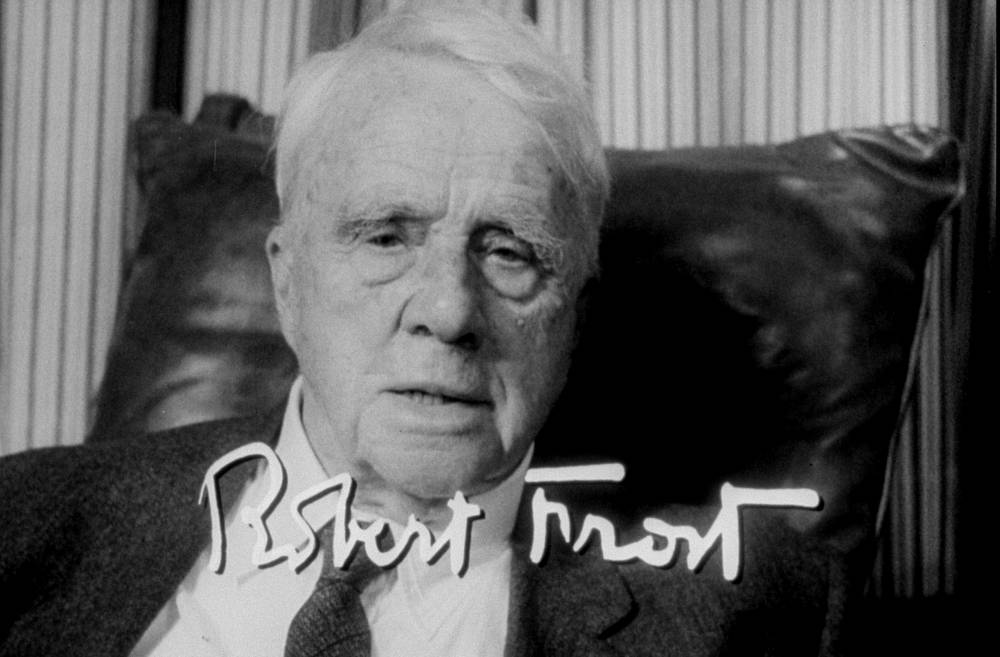
Robert Frost

Robert Frost is a captivating poet and public figure whose approachability and mystique will assuredly engross many generations of scholars, whether their approach is biographical, cultural, or theoretical. Frost’s portions, inscriptions, and random poems will continue to surface until nearly all of the items in small, private collections find their way into shared annals. They in fact add enormously to our interpretation of how Frost worked through his ideas. Paired with poems or excerpts from Frost’s works, these repeatedly sumptuously and lavishly created greetings raise captivating questions about the interaction between the visual and the verbal in Frost’s work.

Stopping by Woods on a Snowy Evening is a poem by Robert Frost, published in the collection New Hampshire (1923). One of the most famous, as well as one of the most anthologized, of Frost’s poems. It portrays a lone traveler in a horse-drawn carriage who is both driven by the business at hand and mesmerized by a frosty woodland setting. The poem is written of four iambic tetrameter quatrains, and the contemplative lyric derives its incantatory tone from an interlocking rhyme scheme of aaba bbcb ccdc dddd:

Whose woods these are I think I know.
His house is in the village though;
He will not see me stopping here
To watch his woods fill up with snow.
 
My little horse must think it queer
To stop without a farmhouse near
Between the woods and frozen lake
The darkest evening of the year.
 
He gives his harness bells a shake
To ask if there is some mistake.
The only other sound’s the sweep
Of easy wind and downy flake.
 
The woods are lovely, dark and deep,
But I have promises to keep,
And miles to go before I sleep,
And miles to go before I sleep.

No American poet has been more prosaic than Robert Frost—prosaic because many readers like to believe most of his poems are narrative in nature, not just the lyrical representation of an image or a feeling.

Eternity Looking through Time

'The Poetry of Robert Frost: The Collected Poems' by Robert Frost (ISBN 0805069860) Frost’s poem has the back drop of a late dark wintry sundown, a harsh and bitter winter (“The darkest evening of the year”). The physical setting of the work is the deserted woods far off from the village. The significance along with physical landscapes of the poem is dreadfully isolated, bare of any living flowers or leafy trees. The narrator of “Stopping by Woods” is compelled to make a significant ethical choice, which his cherished horse does not seem to concur with. The preference that the narrator must grapple with is whether to return to the cordiality and safety of the village (where the owner of the woods lives) and his home or to stay and watch the beautiful woods filling up with fluffy snowflakes on a wintry evening. The narrator does seem to have trouble making his decision, torn between two equally enticing and delightful possibilities. This kind of persistence upon human choice is distinctive of most of Frost’s poetical works. The narrator eventually chooses to return to the village even though it seems to take his great self-control or willpower. He understands that he has some social or civic duty or responsibility to achieve before he dies.

The night, as well as the winter, is closely related to old age, pain, loneliness, and death. As stunning as snow looks, it implies the cold wintry weather, which is in turn connected with despair, disintegration, and death. Just as the woods are “lovely, dark and deep” to him, so does death look to him. Death seems not to be so unnerving, grim, or even scary—but rather fascinating, welcoming, almost a feeling of relief. The narrator is reminded of the final destination of his journey—probably to the village where his home is. The narrator’s “little horse” is perplexed by his master’s conduct —stopping by the woods located far away from any farmhouse—and thus jiggles his harness bells in impulsiveness. Impatient, the horse prompts him to resume his homeward journey.
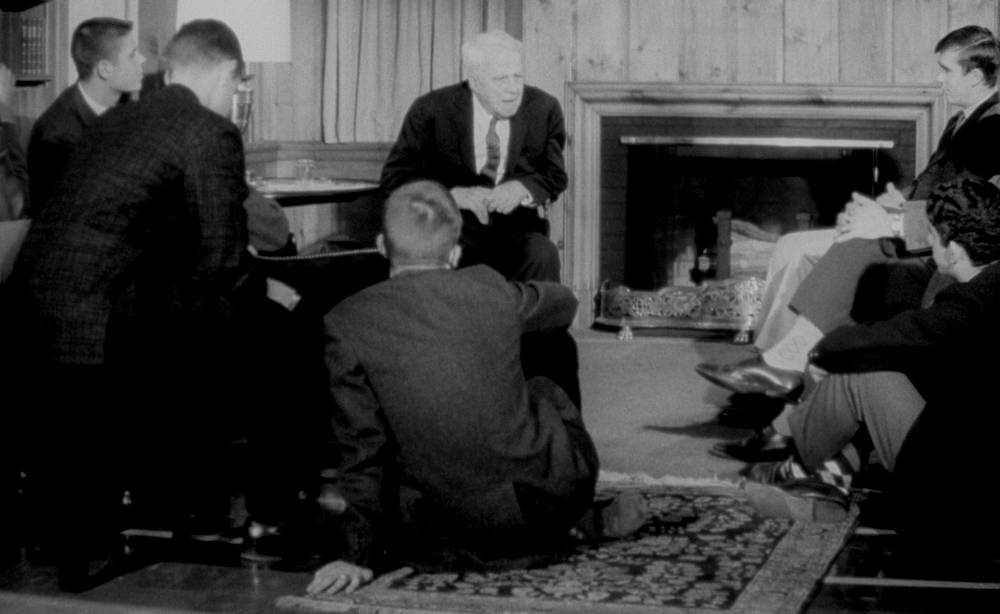
Robert Frost Narrating and Speaking

“My Best Bid for Remembrance”

In a message to American poet, anthologist, and literary critic Louis Untermeyer, American poet Robert Frost called his famous poem “Stopping by Woods on a Snowy Evening” as “my best bid for remembrance.”

According to an essay by N. Arthur Bleau, Robert Frost described the poem’s back-story during a reading at Bowdoin College in 1947:

Robert Frost revealed his favorite poem to me. Furthermore, he gave me a glimpse into his personal life that exposed the mettle of the man. I cherish the memory of that conversation, and vividly recall his description of the circumstances leading to the composition of his favorite work.

'The Road Not Taken and Other Poems' by Robert Frost (ISBN 0486275507) We were in my hometown—Brunswick, Maine. It was the fall of 1947, and Bowdoin College was presenting its annual literary institute” for students and the public. Mr. Frost had lectured there the previous season; and being well received, he was invited for a return engagement.

I attended the great poet’s prior lecture and wasn’t about to miss his encore—even though I was quartered 110 miles north at the University of Maine. At the appointed time, I was seated and eagerly awaiting his entrance—armed with a book of his poems and unaware of what was about to occur.

He came on strong with a simple eloquence that blended with his stature, bushy white hair, matching eyebrows, and well-seasoned features. His topics ranged from meter to the meticulous selection of a word and its varying interpretations. He then read a few of his poems to accentuate his message.

At the conclusion of the presentation, Mr. Frost asked if anyone had questions. I promptly raised my hand. There were three other questioners, and their inquiries were answered before he acknowledged me. I asked, “Mr. Frost, what is your favorite poem?” He quickly replied, “They’re all my favorites. It’s difficult to single out one over another!”

“But, Mr. Frost,” I persisted, “surely there must be one or two of your poems which have a special meaning to you—that recall some incident perhaps.” He then astonished me by declaring the session concluded; whereupon, he turned to me and said, “Young man, you may come up to the podium if you like.” I was there in an instant.

We were alone except for one man who was serving as Mr. Frost’s host. He remained in the background shadows of the stage. The poet leaned casually against the lectern—beckoning me to come closer. We were side by side leaning on the lectern as he leafed the pages of the book.

“You know—in answer to your question—there is one poem which comes readily to mind; and I guess I’d have to call it my favorite,” he droned” in a pensive manner. “I’d have to say ‘Stopping by Woods on a Snowy Evening’ is that poem. Do you recall in the lecture I pointed out the importance of the line “The darkest evening of the year’?” I acknowledged that I did, and he continued his thoughtful recollection of a time many years before. “Well—the darkest evening of the year is on December twenty-second—which is the shortest day of the year—just before Christmas.”

'Robert Frost's Poems' by Robert Frost (ISBN 0312983328) I wish I could have recorded the words as he reflectively meted out his story, but this is essentially what he said.

The family was living on a farm. It was a bleak time both weatherwise and financially. Times were hard, and Christmas was coming. It wasn’t going to be a very good Christmas unless he did something. So—he hitched up the wagon filled with produce from the farm and started the long trek into town.

When he finally arrived, there was no market for his goods. Times were hard for everybody. After exhausting every possibility, he finally accepted the fact that there would be no sale. There would be no exchange for him to get a few simple presents for his children’s Christmas.

As he headed home, evening descended. It had started to snow, and his heart grew heavier with each step of the horse in the gradually increasing accumulation. He had dropped the reins and given the horse its head. It knew the way. The horse was going more slowly as they approached home. It was sensing his despair. There is an unspoken communication between a man and his horse, you know.

Around the next bend in the road, near the woods, they would come into view of the house. He knew the family was anxiously awaiting him. How could he face them? What could he possibly say or do to spare them the disappointment he felt?

They entered the sweep of the bend. The horse slowed down and then stopped. It knew what he had to do. He had to cry, and he did. I recall the very words he spoke. “I just sat there and bawled like a baby”—until there were no more tears.

'Robert Frost Poet as Philosopher' by Peter Stanlis (ISBN 1933859814) The horse shook its harness. The bells jingled. They sounded cheerier. He was ready to face his family. It would be a poor Christmas, but Christmas is a time of love. They had an abundance of love, and it would see them through that Christmas and the rest of those hard times. Not a word was spoken, but the horse knew he was ready and resumed the journey homeward.

The poem was composed some time later, he related. How much later I do not know, but he confided that these were the circumstances which eventually inspired what he acknowledged to be his favorite poem.

I was completely enthralled and, with youthful audacity, asked him to tell me about his next favorite poem. He smiled relaxedly and readily replied, “That would have to be ‘Mending Wall.’ Good fences do make good neighbors, you know! We always looked forward to getting together and walking the lines—each on his own side replacing the stones the winter frost had tumbled. As we moved along, we’d discuss the things each had experienced during the winter—and also what was ahead of us. It was a sign of spring!”

The enchantment was broken at that moment by Mr. Frost’s host, who had materialized behind us to remind him of his schedule. He nodded agreement that it was time to depart, turned to me and with a smile extended his hand. I grasped it, and returned his firm grip as I expressed my gratitude. He then strode off to join his host, who had already reached the door at the back of the stage. I stood there watching him disappear from sight.

I’ve often wondered why he suddenly changed his mind and decided to answer my initial question by confiding his memoir in such detail. Perhaps no one had ever asked him; or perhaps I happened to pose it at the opportune time. Then again—perhaps the story was meant to be related, remembered and revealed sometime in the future. I don’t know, but I’m glad he did—so that I can share it with you.

Two Minds About It

'Robert Frost A Life' by Jay Parini (ISBN 0805063412) Frost’s daughter Lesley later validated the narrative and quoted her father reminiscing his weeping, “A man has as much right as a woman to a good cry now and again. The snow gave me shelter; the horse understood and gave me the time.”

For many years I have assumed that my father’s explanation to me, given sometime in the forties, I think, of the circumstances round and about his writing “Stopping by Woods” was the only one he gave (of course, excepting to my mother), and since he expressed the hope that it need not be repeated fearing pity (pity, he said, was the last thing he wanted or needed), I have left it at that. Now, in 1977, I find there was at least one other to whom he vouchsafed the honor of hearing the truth of how it all was that Xmas eve when “the little horse” (Eunice) slows the sleigh at a point between woods, a hundred yards or so north of our farm on the Wyndham Road. And since Authur Bleau’s moving account is closely, word for word, as I heard it, it would give me particular reason to hope it might be published. I would like to add my own remembrance of words used in the telling to me: “A man has as much right as a woman to a good cry now and again. The snow gave me its shelter; the horse understood and gave me the time.” (Incidentally, my father had a liking for certain Old English words. Bawl was one of them. Instead of “Stop crying,” it was “Oh, come now, quit bawling.” Mr. Bleau is right to say my father bawled like a baby.)
Get to Know the 12 Disciples of Jesus Christ: Apostle #8: Jude Thaddeus

Get to Know the 12 Disciples of Jesus Christ: Apostle #8: Jude Thaddeus

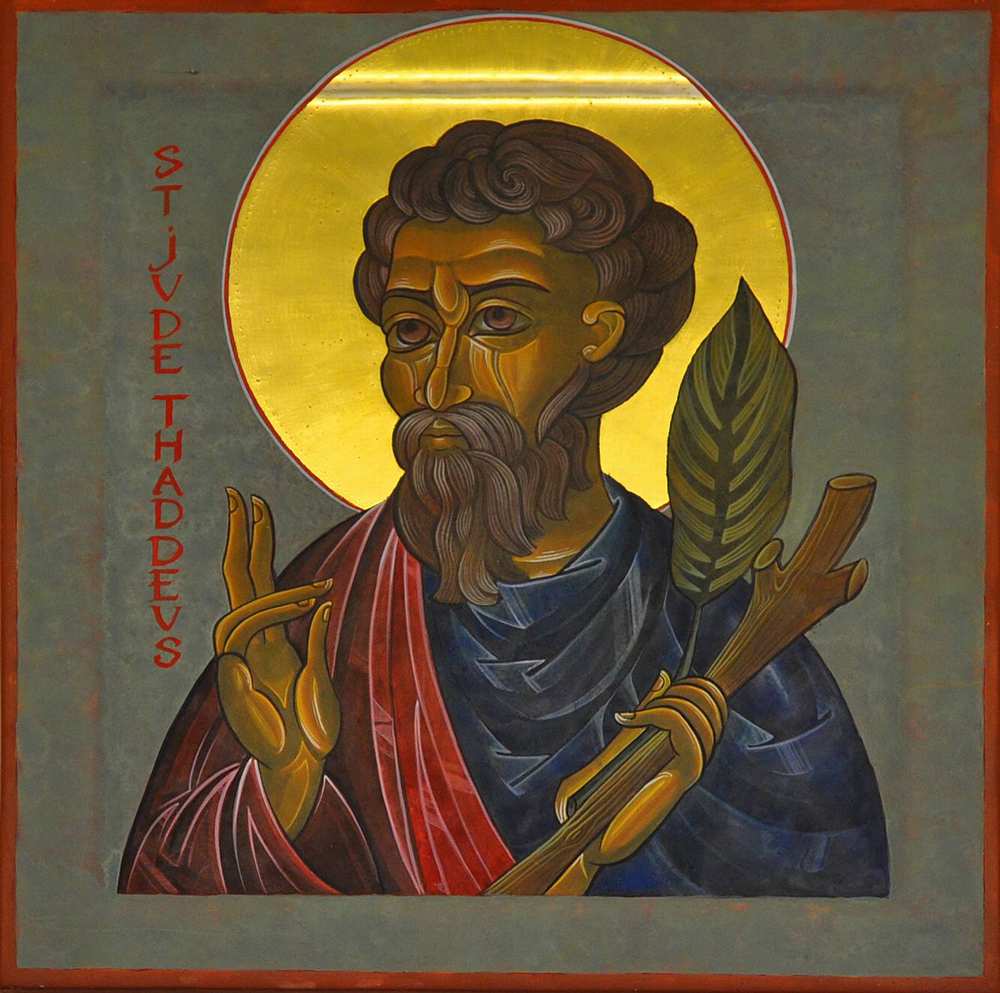
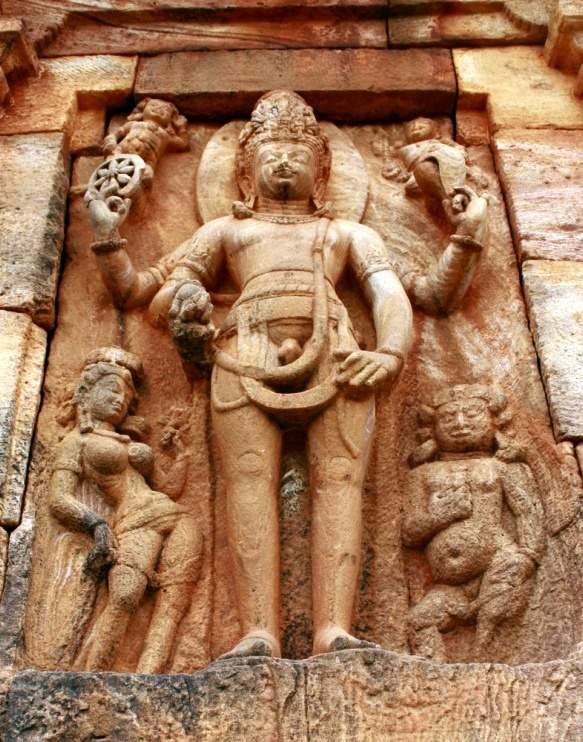
The Gospels mention Jude Thaddaeus in the list of the holy Twelve. Sometimes he is called “Lebbaeus;” however the Aramaic meaning of Thaddaeus and Lebbaeus is the same, “beloved” or “dear to the heart.”

The Fourth Gospel tells us that Thaddaeus asked Jesus, “How is it that you will reveal yourself to us and not to the world?” And Jesus answered, “If a man loves me and obeys my teachings, my father and I will love him and we will come to him and abide with him” (see John I 4:22–23.) Many scholars believe it was the last question Jesus answered before he began his prayer vigil in the Garden of Gethsemane prior to his arrest.

Thaddaeus’s esteemed reputation as a miracle-worker may be due to a legend concerning Abgar of Oseoene—the twenty-eight-year-old king of a small, prosperous domain located some 400 miles from Jerusalem. Shortly before Jesus’ arrest, the young king wrote to Jesus asking to be cured of a painful disease. Though Abgar never met Jesus, he accepted him as the Savior, and warned that in Jerusalem there were plots against Jesus’ life. Abgar offered his own kingdom as sanctuary, saying, “I have a very small yet noble city which is big enough for us both.”

Jude Thaddeus - Holy Days - Eastern and Western Churches

He is titled Jude in the lists of Luke 6.16 and Acts 1.13. Certain scholars believe that Thaddeus is an alternative of the Greek name Theudas. According to a very early tradition in the Church the James referred to in “Jude of James” is JAMES, son of Alphaeus, and James and Jude are to be recognized with the BROTHERS OF JESUS (i.e., His relatives) mentioned in Mt 13.55 and Mk 6.3. Furthermore, since Jude was probably less known, to recognize him better his name was associated with that of his brother. This has persisted the principal view among Catholic commentators.

Although Jesus graciously declined the invitation, Abgar was promised that an apostle would be sent to cure him. After the Ascension, Thaddaeus was chosen to travel to Oseoene. He healed the king and many others as well. The legend ends with the grateful Abgar offering Thaddaeus a large sum of gold and silver. But Thaddaeus refused, saying, “If we have forsaken that which is our own, how shall we take that which is another’s?”

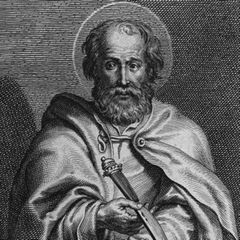
The traditional material about Jude Thaddeus’s later ministry and martyrdom is completely unreliable. Eusebius (Ecclesiastical History 2.40) relates various assumed areas of his preaching, while the Roman Breviary mentions only Mesopotamia and Persia. He is said to have died a martyr, and in art he is represented with a halberd, the means of his martyrdom.

Jude Thaddeus - Saint of Lost Causes for Christians in France and Germany

  • Since the eighteenth century, Christians in France and Germany have prayed to Jude Thaddaeus as the Saint of Lost Causes; today he continues to be petitioned by many Christians throughout the world. His symbol is a gold sailing ship with silver sails before a red horizon.
  • Holy days: Eastern churches celebrate Thaddaeus on June l9; in the West; with the apostle Simon on October 28.

Zen Koan #4: Parable of Obedience – Buddhist Teaching on the Art of Living

Zen Koan #4: Parable of Obedience - Buddhist Teaching on the Art of Living Zen is an interesting method of communicating enlightenment; however, enlightenment does not differ between the many varieties of faiths or religions. Anyhow, yes, there are enlightened people who use Zen nowadays, but none who are enlightened in Zen. For instance, this incense board is just a piece of wood. A sick person may absorb this energy and this may avail them to practice preponderant. Practicing this goodness will avail the process of their rejuvenating. However, because of incognizance and delusion, we keep following this cycle. We carry out many activities, and develop many affixments to this life.
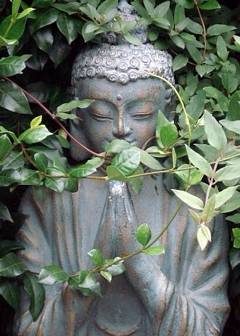
We endeavor many incipient things in order to gratify ourselves. We chase after pleasure and we endeavor to evade or discard those things we do not relish. From this concentrated state, we can enter the mind of unity. Tibetan Zen Buddhism as we know it today was shaped in part by arguments over how best to present Zen Buddhist teachings. Great space does not refer to nothingness, but rather to a totality. No ghosts or deities would be able to find you. Some people become so overwhelmed by troubles in their practice, they end up without any discrimination, letting go of their hopes as well as their despair.

Zen Koan: “Obedience” Parable

The master Bankei’s talks were attended not only by Zen students but by persons of all ranks and sects. He never quoted sutras not indulged in scholastic dissertations. Instead, his words were spoken directly from his heart to the hearts of his listeners.

His large audience angered a priest of the Nichiren sect because the adherents had left to hear about Zen. The self-centered Nichiren priest came to the temple, determined to have a debate with Bankei.

“Hey, Zen teacher!” he called out. “Wait a minute. Whoever respects you will obey what you say, but a man like myself does not respect you. Can you make me obey you?”

“Come up beside me and I will show you,” said Bankei.

Proudly the priest pushed his way through the crowd to the teacher.

Bankei smiled. “Come over to my left side.”

The priest obeyed.

“No,” said Bankei, “we may talk better if you are on the right side. Step over here.”

The priest proudly stepped over to the right.

“You see,” observed Bankei, “you are obeying me and I think you are a very gentle person. Now sit down and listen.”

Buddhist Insight on An Art of Living

The art of Zen living requires, if you come to something that’s in the middle of the road, even if it’s not your lane, it’s a nice thing to pick it up, move it aside, because you care for the earth; not because you’re intended to, but because it brings joy. At first, it’s difficult, but if you work with it for a while, it actually starts to become interesting. The Burmese-Indian teacher of Vipassana meditation S. N. Goenka writes in The Art of Living,

By learning to remain balanced in the face of everything experienced inside, one develops detachment towards all that one encounters in external situations as well. However, this detachment is not escapism or indifference to the problems of the world. Those who regularly practice Vipassana become more sensitive to the sufferings of others and do their utmost to relieve suffering in whatever way they can – not with any agitation, but with a mind full of love, compassion and equanimity. They learn holy indifference – how to be fully committed, fully involved in helping others, while at the same time maintaining balance of mind. In this way they remain peaceful and happy while working for the peace and happiness of others.

This is what the Buddha taught: an art of living. He never established or taught any religion, any “ism.” He never instructed those who came to him to practice any rites or rituals, any empty formalities. Instead, he taught them just to observe nature as it is by observing the reality inside. Out of ignorance, we keep reacting in ways which harm ourselves and others. But when wisdom arises – the wisdom of observing reality as it is – this habit of reacting falls away. When we cease to react blindly, then we are capable of real action – action proceeding from a balanced mind, a mind which sees and understands the truth. Such action can only be positive, creative, helpful to ourselves and others.

Zen Koan #3: Parable of Is That So? – Buddhist Teaching on Achievement

Zen Koan #3: Parable of Is That So? - Buddhist Teaching on Achievement Zen Meditation is arduous. Cogitation sanctions you to optically discern something fresh that you’ve never optically discerned afore or to understand something incipient that you’ve never understood afore. As in actual dreams, these wandering thoughts either are connected with the past, or anticipate the future. At that point, there are no more vexations.

This is not the case for mundane people. In most religions, if you reach a stage where you identify planarity with the macrocosm, it would be considered the ultimate or great harmony. Others honor the rule and refrain from speaking, but that does not mean that they are not talking to themselves. The basic thing is that they find out what their strengths are in body and mind, and how they can follow the precepts. Nor should you be concerned with anything going on inside yourself.

After practicing diligently, you will gradually resolve the problem of doubt. When practice sets in, rather the way weather does, there can be a lot of boredom and feeling clueless, so that cluelessness or plainness is something that always needs to be taken into account. This is for the reason that your mind is divided into two, or even three: a sense of yourself, of your body, and of the pleasure.

Zen Koan: “Is That So?” Parable

The Zen master Hakuin was praised by his neighbours as one living a pure life.

A beautiful Japanese girl whose parents owned a food store lived near him. Suddenly, without any warning, her parents discovered she was with child.

This made her parents angry. She would not confess who the man was, but after much harassment at last named Hakuin.

In great anger the parent went to the master. “Is that so?” was all he would say.

After the child was born it was brought to Hakuin. By this time he had lost his reputation, which did not trouble him, but he took very good care of the child. He obtained milk from his neighbours and everything else he needed.

A year later the girl-mother could stand it no longer. She told her parents the truth – the real father of the child was a young man who worked in the fishmarket.

The mother and father of the girl at once went to Hakuin to ask forgiveness, to apologize at length, and to get the child back.

Hakuin was willing. In yielding the child, all he said was: “Is that so?”

Buddhist Insight on No Thought of Achievement

If you foster generosity, Zen kindness, awareness, and giving, you will be happy because you’ll learn that it’s pleasant, and the way that karma works is that your world will become more of a steering rather than fear and holding. Within the conventional, relative truth, individual appearances, which accord and do not, are distinguished. Therefore, there isn’t any thought of achievement. Shunryu Suzuki, the Japanese-American Zen monk who helped popularize Zen Buddhism in the United States, writes in Zen Mind, Beginner’s Mind,

In the beginner’s mind there is no thought, “I have attained something.” All self-centered thoughts limit our vast mind. When we have no thought of achievement, no thought of self, we are true beginners. Then we can really learn something. The beginner’s mind is the mind of compassion. When our mind is compassionate, it is boundless. Dogen-zenji, the founder of our school, always emphasised how important it is to resume our boundless original mind. Then we are always true to ourselves, in sympathy with all beings, and can actually practice.

Architectural Marvel of the Chaturmukha Basadi, Gerusoppa in Karnataka

Gerusoppa, Home to Several Basadis (Jain Temples)

Gerusoppa, Home to Several Basadis (Jain Temples)

The municipality of Gerusoppa is located about 30 kms from the well-known Gerusoppa Falls on the banks of Sharavathi river in Honnavar taluk .

Gerusoppa is 25 km from the outlet of Jog Falls—a long time ago functioned as the capital of the Salva empire that reigned over the region between 14th and 15th centuries. Acknowledged to have trade interactions with Europe, the Middle East and Africa, the empire reached its pinnacle under the supremacy of Rani Chennabhairadevi. She governed over contemporary Dakshina Kannada, Udupi, and Uttara Kannada for 54 years: the lengthiest reign by any Indian woman head of state.

Vijayanagara architecture in Jain basadis of Western Ghats Though it was the capital of the Saluva empire, it became famous for the duration of the rule of Queen Channabhairadevi (1548–99 A.D.) famous as the Pepper Queen. (After the fall of the Vijayanagara empire, Queen Chennabhairadevi handled the Portuguese very diplomatically, who nicknamed her ‘Raina de Pimenta’—the Pepper Queen.) Ikkeri chief Hiriya Venkatappa Nayaka defeated the queen and Gerusoppa was abandoned and came to ruins.

Frequently suggested to as the ‘Harappa of Jains’, Gerusoppa is institution to several basadis (Jain temples) with exclusive architecture, hundreds of inscriptions, groups of temples and structures that were all in the past part of an overseas trade hub. Currently, unfortunately, most of them have either been hidden under centuries of earth or endured as ruins, absorbed by the dense forests of the Western Ghats.

Queen Channabhairadevi, Queen of Black Pepper - Benefactor of Jain Temples Basadis in Gerusoppa

Queen Channabhairadevi or ‘Mahamandaleshwari’, Queen of Black Pepper

The history of Jainism in South India and its influence on the life and thought of the people is a fascinating subject. No topic of ancient South Indian history is more thought-provoking than the origin and development of the Jains who, in times past, intensely affected the political, religious and literary establishments of South India. It has occasionally been thought that an associated account of the Jains could not ever be written.

Rani Channabhairadevi Chaturmukha Basadi of Gerusoppa Situated deep inside the evergreen Sharavathi valley on the stores of the Sharavathi river, neither the sanctuaries nor the antique town can be accessed without difficulty. While Jain believers crowd the place in large numbers using private vehicles, the villages are more or less off limits to tourists due to an absence of publicity and information.

Previously known as Haive, Gerusoppa was afterwards named Nagar Bastikeri and subsequently Ngaire. Formerly a famous center of trade and commerce, Gerusoppa was ruled by the Saluva kings. While Honnavar functioned as a harbor for internal trade, nearby Bhatkal was celebrated as an intercontinental harbor.

The Saluva kingdom reached its zenith under the regime of Rani Channabhairadevi, who ruled between 1554 and 1603, and hailed as Mahamandaleshwari. Living the followers of Jainism, the queen organized the creation of the historic Chaturmukha Basadi in 1562. With several ship-loads of pepper and spices being methodically traded to the west, Gerusoppa was often the sticking point between numerous princely states. The rulers of Keladi were frequently at war with Gerusoppa for jurisdiction over the expensive province.

Moreover, Channabhairadevi had gone to war with the Portuguese, who attempted to grab the ports and take the reins of the spice trade. Two times, once in 1559 and then again in 1570, the queen efficaciously crushed the Portuguese maritime force with her military stratagem.

Architectural Marvel of the Chaturmukha Basadi

Architectural Marvel of the Chaturmukha Basadi

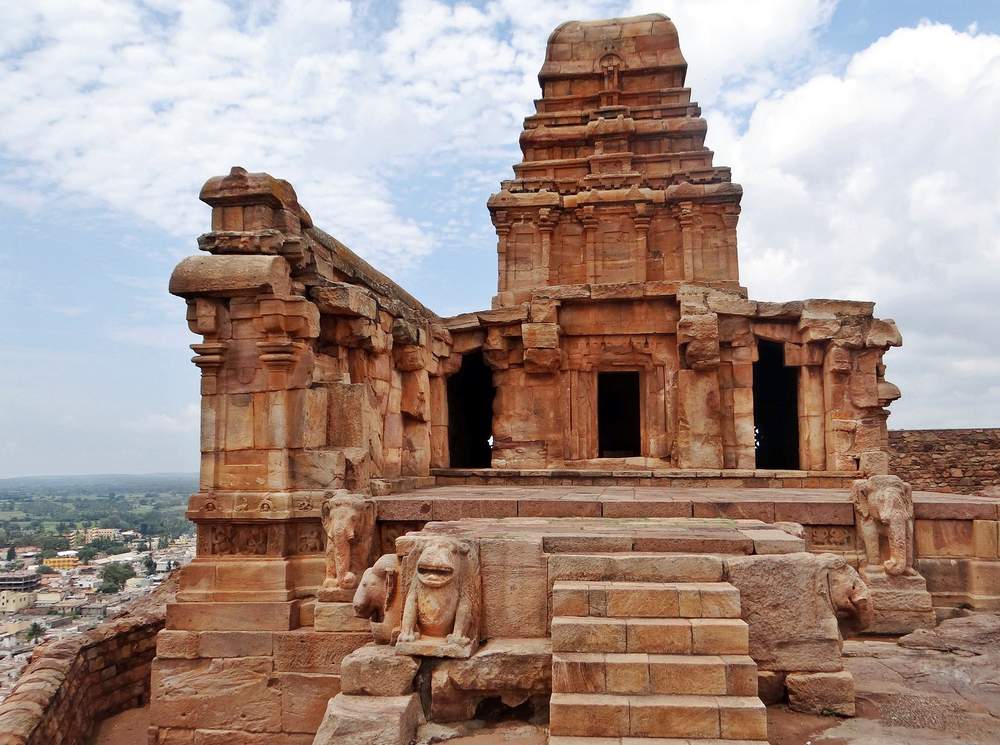
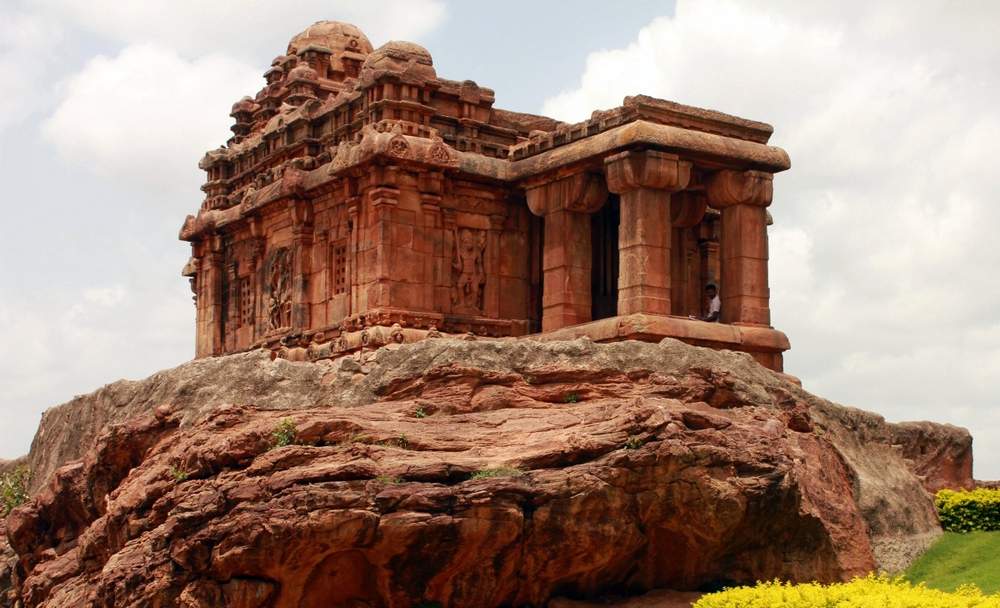
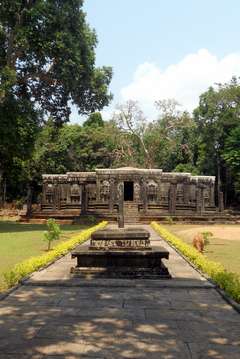
Chaturmukha Basadi is a Jain temple unique in its plan as it is open on all four sides (chaturmukha). It is also called Sarvatobhadra in silpasatra texts. Such temples are unique.

The Chaturmukha basadi has a garbhagriha, antaralas (vestibule), navarangas and four entrances with flight of steps. The entire temple is built on a cellar which is in the shape of a star and provides open circumbulatory passage. The outer walls have ornamented niches some of which have gods and goddesses. There are some jalandhras also.

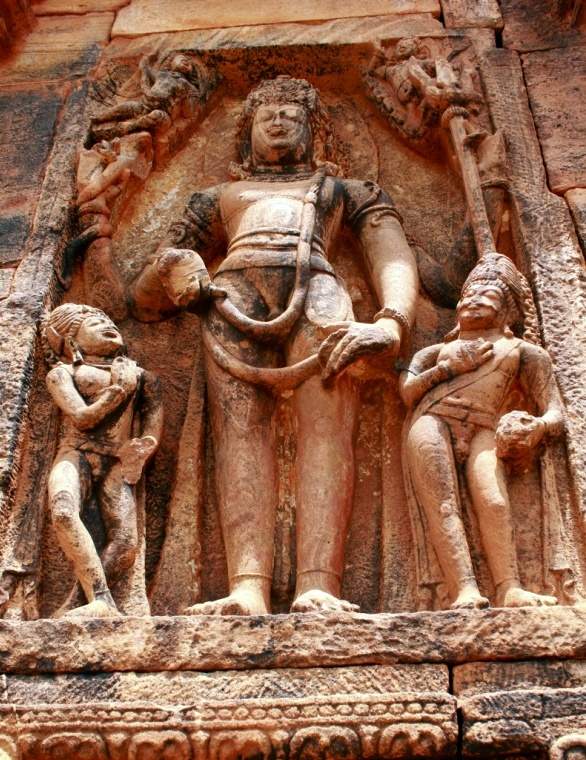
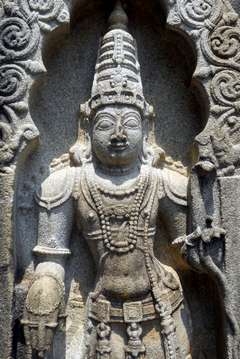
The four access doorways are alike and seated tirthankara is carved on the lintel. On either side are found the high relief sculptures of dvarapalas well bedecked and standing in dvibhanga. The devakoshthas with Dravida and Kadamba Nagara sikharas contain sculptures. Now there is no roof over the whole structure.

Chaturmukha Basadi of Gerusoppa was built by Rani Chennabhairadevi The interior of the Chaturmukha Basadi has navarangas with four prominent pillars in the centre of the enclosure. Thus the sixteen pillars of the Vijayanagara type measure about 10 ft in height. Navaranga is separated by the antarala with a very thick wall. They also have decorated niches to house gods and goddesses.
The three lintels of the doorways have seated tirthankaras although the southern doorway has Gajalakshmi on its lintel. Then there are four antaralas each of which has two decorated pillars. Thus there are eight such pillars.

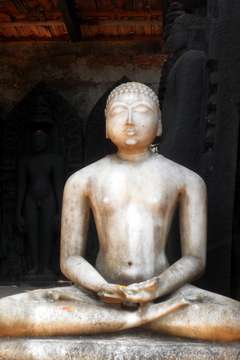
The sole garbhagriha has four seated tirthankaras each facing a different direction. This gives a meaning to the structure fronting four directions. These four tirthankara sculptures are made of black stone and have high glossy polish.

There are no historical chronicles to know the patron of this exclusive Jain temple. But it is commonly judged that Queen Channabhairadevi built this temple. Even the contemporaneous explorer Pietro Della Valle is silent about it. From the stylistic substantiation this temple may be dated to sixteenth century A.D.

Acclaimed as an architectural marvel, Chaturmukha Basadi was built by Rani Chennabhairadevi back in 1562. Constructed in granite, the Basadi has remained out-of-bounds to sightseers. Constructed in the Vijayanagara style, the basadi has four entrances, one in each of the four compass points, all fronting to the sanctum sanctorum. Though no official prayer rituals are done at the Chaturmukha basadi, the Parshawanatha basadi, or the Neminatha basadi, recurrent prayers and pooja services are organized at the close by Jwalamalini temple.

Zen Koan #2: Parable of Finding a Diamond on a Muddy Road – Buddhist Teaching on Creativity

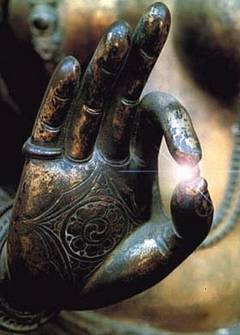
Zen Koan #2: Parable of Finding a Diamond on a Muddy Road - Buddhist Teaching on Creativity Zen is not unique. All forms of Zen Buddhism point to this same authenticity. Zen just uses fewer words in this process. Still, the unfamiliar will take the moon in the dehydrogenate monoxide for the authentic moon and point their finger towards it in vain where others misunderstand the finger for the authentic thing. Sometimes it’s better to verbalize. You have an excess of what you want to be rid of, and a lack of what you want to acquire. Pretending sundry relishes and misprices severs you from the Way.
Consider the story about an inexperienced farmer who planted a field of rice. The more you drive yourself the tenser you will feel. The role of the monitor is that if they see a person sitting in the cave of the devil, in that wonderful space, that peaceful space, they knock them out of it. Thus to say that this principle is not eternal would also be incorrect. When we see the discrepancy between our good intentions and our actions, it motivates us to work with our minds, to work with our habitual reactions and our impatience.

Zen is so strict and austere, yet at the heart of its teaching is spontaneity. In Taoism, there is the verbalization that the one gives elevate to the two, and the two give elevate to the multiplicity of things.

Zen Koan: “Finding a Diamond on a Muddy Road” Parable

Gudo was the emperor’s teacher of his time. Nevertheless, he used to travel alone as a wandering mendicant. Once when he was on his way to Edo, the cultural and political center of the shogunate, he approached a little village named Takenaka. It was evening and a heavy rain was falling. Gudo was thoroughly wet. His straw sandals were in pieces. At a farmhouse near the village he noticed four or five pairs of sandals in the window and decided to buy some dry ones.

The woman who offered him the sandals, seeing how wet he was, invited him in to remain for the night in her home. Gudo accepted, thanking her. He entered and recited a sutra before the family shrine. He was then introduced to the women’s mother, and to her children. Observing that the entire family was depressed, Gudo asked what was wrong.

“My husband is a gambler and a drunkard,” the housewife told him. “When he happens to win he drinks and becomes abusive. When he loses he borrows money from others. Sometimes when he becomes thoroughly drunk he does not come home at all. What can I do?”

“I will help him,” said Gudo. “Here is some money. Get me a gallon of fine wine and something good to eat. Then you may retire. I will meditate before the shrine.”

When the man of the house returned about midnight, quite drunk, he bellowed: “Hey, wife, I am home. Have you something for me to eat?”

“I have something for you,” said Gudo. “I happened to be caught in the rain and your wife kindly asked me to remain here for the night. In return I have bought some wine and fish, so you might as well have them.”

The man was delighted. He drank the wine at once and laid himself down on the floor. Gudo sat in meditation beside him.

In the morning when the husband awoke he had forgotten about the previous night. “Who are you? Where do you come from?” he asked Gudo, who was still meditating.

“I am Gudo of Kyoto and I am going on to Edo,” replied the Zen master.

The man was utterly ashamed. He apologized profusely to the teacher of his emperor.

Gudo smiled. “Everything in this life is impermanent,” he explained. “Life is very brief. If you keep on gambling and drinking, you will have no time left to accomplish anything else, and you will cause your family to suffer too.”

The perception of the husband awoke as if from a dream. “You are right,” he declared. “How can I ever repay you for this wonderful teaching! Let me see you off and carry your things a little way.”

“If you wish,” assented Gudo.

The two started out. After they had gone three miles Gudo told him to return. “Just another five miles,” he begged Gudo. They continued on.

“You may return now,” suggested Gudo.

“After another ten miles,” the man replied.

“Return now,” said Gudo, when the ten miles had been passed.

“I am going to follow you all the rest of my life,” declared the man.

Modern Zen teachings in Japan spring from the lineage of a famous master who was the successor of Gudo. His name was Mu-nan, the man who never turned back.

Buddhist Insight on Creativity: Being and Doing

By the profound interdependence of being and doing, all anger is prompted and polluted by improper conceptuality. It’s that Zen spirit of heartfulness and creativity, of mindfulness that it comes to. However, there are other kinds of happiness that are very unpretentious and really nurturing of spiritual life, that touching them actually gives us the strength to deal with difficulties. The American clinical psychologist John Welwood, who frequently writes about the integration of psychological and spiritual concepts, writes in Ordinary Magic, Everyday Life as Spiritual Path,

The key to everyday life as spiritual practice lies in bringing a full, rich, quality of being and presence into whatever we do. Yet “being” and “doing” often seem mutually exclusive. The cultures of the East have cultivated being for thousands of years, while rarely, until recently, placing as much emphasis on doing. The cultures of the West have been busy doing for thousands of years – building, inventing, conquering the world – while often failing to appreciate that a healthy, fulfilling human life, depends on the quality of one’s being and presence. To find the spiritual path in our daily life, we need to bring being and doing together. This is precisely what happens in creativity, where the beauty that we love can become what we do.

Get to Know the 12 Disciples of Jesus Christ: Apostle #7: Bartholomew

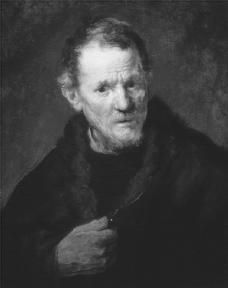
The Apostle Bartholomew by Rembrandt Harmensz van Rijn After Philip was chosen by Jesus, he sought out his close friend Bartholomew and told him, “We have found the one Moses wrote about … and of whom the Prophets also wrote—Jesus of Nazareth, the son of Joseph.” But Bartholomew said, “Nazareth! Can anything good come from there?” “Come and see,” Philip answered. When Jesus saw Bartholomew approaching, he observed, “This man is a true Israelite, in whom there is nothing false.” “How do you know me?” Bartholomew asked, and Jesus answered, “I saw you while you were still under the fig tree before Philip called you.” Then Bartholomew declared, “Master, you are the Son of God; you are the King of Israel” (John I: 44–51)
Bartholomew is described in The Apostolic History of Abdias (Bishop of Babylonia ordained by the apostles) as a man of middle height with long curly black hair, large eyes, straight nose, and a thick beard. Always cheerful, he had a voice like a trumpet, and knew all languages. Twenty-six years he wore the same white robe with a purple stripe, and a white cloak; yet the garments never tattered or soiled.

Bartholomew’s ministry belongs to the tradition of the Eastern churches. He traveled to Asia Minor (Turkey), perhaps in the company of Philip, where he labored in Hierapolis. In the region the ancients referred to as India (The term ‘India’ was used indiscriminately to refer to Arabia, Ethiopia, Libya, Parthia, and the Medes.) it is said that “Bartholomew, one of the Apostles” left behind the Hebrew Gospel of Matthew.

Apostle Bartholomew: The Patron Saint of Dermatology

Apostle Bartholomew and the Question of Nathanael’s Identity

In his long life Bartholomew performed many wonderful feats, including the healing of the sick. With the aid of an angel, he banished from a false idol a demon-described as “sharp-faced, with a long beard, hair to its feet, fiery eyes, breath of flames, and spiky wings.” An Apocryphal Gospel of Bartholomew remains to this day.

Apostle Bartholomew synonymous with Nathanael of Galilee The discrepancy between the synoptic material and the Johannine material has been the cause of much speculation over the centuries. The question of Nathanael’s identity has led many to explore further the identity of Bartholomew. Whenever Bartholomew’s name is revealed in the Synoptic Gospels (Matthew 10:1-4, Mark 3:13-16, and Luke 6:12-16), he is also declared as being in the company of Philip.
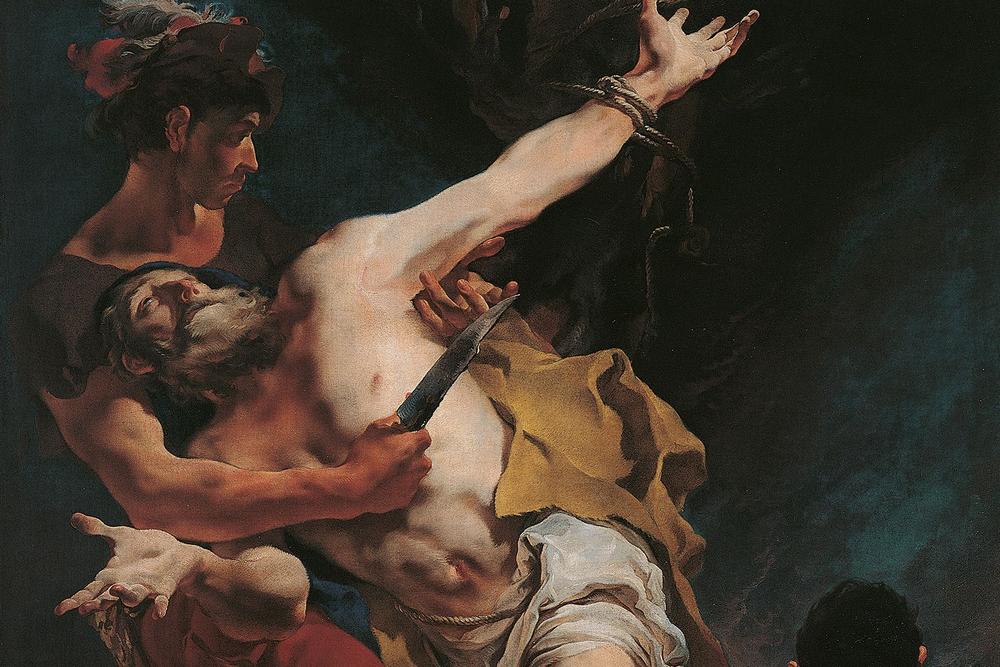
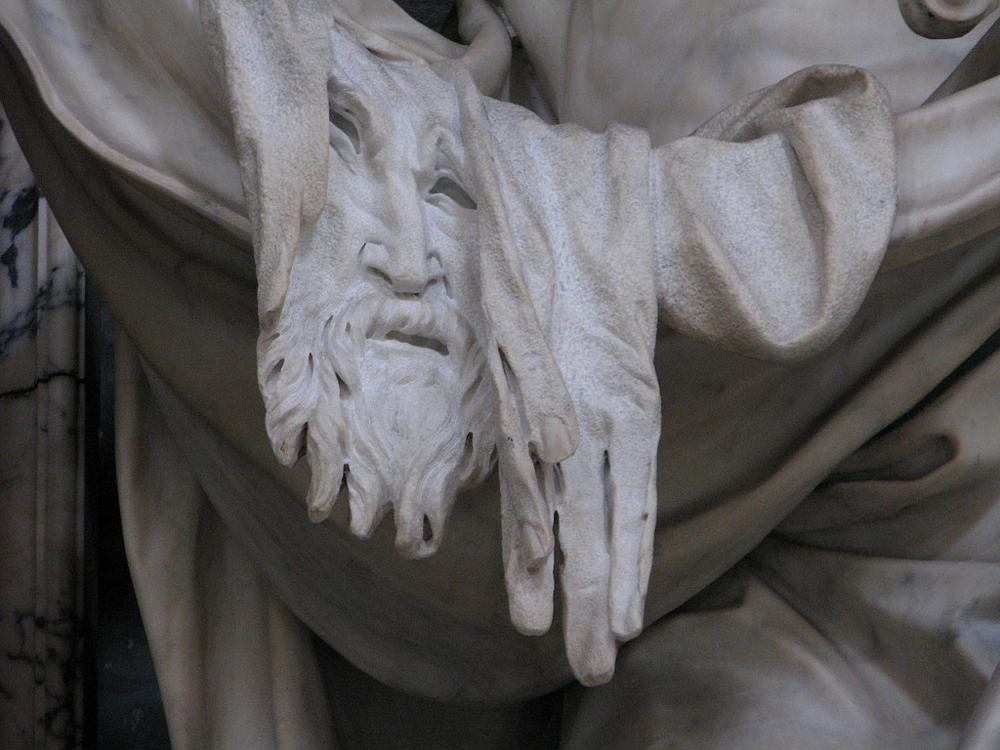
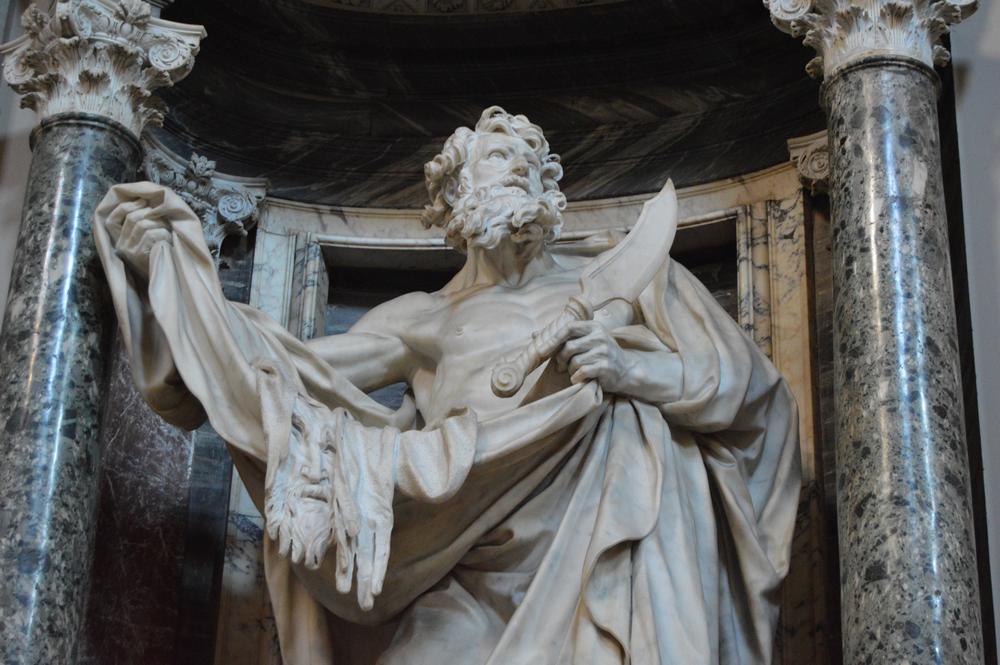
  • The Armenian Church claims the holy apostle Bartholomew as their founder. In art he is often depicted beside a chained demon; his symbol is a knife blade.
  • Holy days of Apostle Bartholomew: in the East, June 11; in the West, August 24.
  • Apostle Bartholomew is also known as Nathanael. He is mentioned as Bartholomew, one of “the Twelve” in Matthew 10:3, Mark 3:18; Luke 6:14; and Acts 1:13. There is no further mention in the New Testament. However, John I:45 refers to him as Nathanael, which has led theologians to believe that Bartholomew and Nathanael are the same person.

Apocryphal Gospel of Saint Bartholomew

Apostle Bartholomew: The Patron Saint of Dermatology

Bartholomew has long been associated with skin diseases and may be considered the patron saint of dermatology. This characteristic is attributed to one theory concerning his proposed manner of death. When Bartholomew cured the daughter of King Polymios of Armenia, the King adapted Christianity. Consequently, Astyages, the King’s brother, condemned St Bartholomew to be whipped and skinned alive, after which he was crucified upturned.

In the Sistine Chapel, Apostle Bartholomew is portrayed in Michelangelo’s “Last Judgment” as lashed and holding his own skin in his left hand. In Marco d’Agrate’s sculpture of St Bartholomew, found in the Basilica of Santa Maria della Steccata in Parma, Italy, he is represented carrying his skin round his body similar to a coat or blanket. As a consequence of this ghastly history, he has been renowned as the saint of dermatology. This connotation has also gotten him the label of patron saint of tanning, in which animal skin is detached and processed to produce functional goods.

Apostle Bartholomew: The Patron Saint of Dermatology

Little is known about St Bartholomew’s life, other than that he was born in Galilee in the first century and served as one of Jesus’s 12 apostles. Even his correct name is uncertain, as his name can mean “son of Tolmay” or “son of the furrows.” Per se, he is often thought to be synonymous with Nathanael of Galilee, who was introduced to Jesus through his apostle Philip.

Several other stories of St Bartholomew’s death exist, involving one in which he was abducted, beaten, and cast into the sea to drown. Afterward, his body amazingly washed up at Lipari, a small island off the coast of Sicily. Close by, a large piece of his skin and bones were kept as relics at the Cathedral of St Bartholomew the Apostle. Over time, this church opened a medical facility, and St Bartholomew’s name and relics became associated with medicine and skin disease.

The Controversial Differences of Opinion between Rabindranath Tagore and Mahatma Gandhi

Described as a “world poet,” Rabindranath Tagore is considered a mystifying ecumenical figure and an archetype of human creative possibility. Rabindranath Tagore bestowed the title of ‘Mahatma’ (“Great Soul”) on Mohandas Karamchand Gandhi in 1915. Mahatma Gandhi called Tagore Gurudev (“Revered Master”) and he attained a certain classicality. Tagore’s literary works have universal appeal and that illuminates his complexity and “myriad-mindedness.”

Nevertheless, experts have said that although Tagore admired Gandhi, he differed with him on specific issues.

The Controversial Differences of Opinion between Rabindranath Tagore and Mahatma Gandhi

“Tagore admired Mahatma Gandhi immensely and expressed his admiration for his leadership time and again, but sharply differed with him when Gandhi was departing from adequate reasoning,” Nobel-prize winning economist Amartya Sen once said.

After the Nepal-Bihar earthquake of 1934, Gandhi credited the disaster to the custom of untouchability among Biharis. Gandhi had said the earthquake was “a divine chastisement for the great sin we have committed against those whom we describe as Harijans”.

Although Tagore was against untouchability, he found this line of reasoning on Gandhi’s part unfounded and irrational.

Apparantly, Tagore shot off a refutation on rationalist lines, with a appeal for it to be published in Gandhi’s periodical, Harijan. The correspondence expressed “painful surprise” at “this kind of unscientific view of things”. It was plainly erroneous, Gurudev argued, to “associate ethical principles with cosmic phenomena”:

In the Harijan issue of 16 February, 1934, Tagore wrote his article The Bihar Earthquake to which Gandhi wrote his rejoinder Superstitions vs. Faith (pp. 115-121). Tagore considered Gandhi’s view that untouchability had brought down God’s vengeance upon certain parts of Bihar in the form of an earthquake as ‘unfortunate’, ‘unscientific’ and “too readily accepted by a large section of countrymen” (pp. 115): “If we associate ethical principles with cosmic phenomena, we shall have to admit that human nature is superior to Providence that preaches its lessons in good in orgies of the worst behaviour possible” (p.116). This amounts to “making indiscriminate examples of casual victims…in order to impress other at a safe distance who possibly deserve severer condemnation” (p 116). He felt the kind of argument that Gandhi used by exploiting an event of cosmic disturbance far better suited the psychology of his opponents than his own; and, “We, who are immensely grateful to Mahatmaji for inducing, by his wonderworking inspiration, freedom from fear and feebleness in the minds of his countrymen, feel profoundly hurt when any words from his mouth may emphasize the elements of unreason in those very minds — unreason which is a source of all blind powers that drive us against freedom and self-respect”. (p117).

Differences of Opinion between Rabindranath Tagore and Mahatma Gandhi

To this, Gandhi had replied that he felt phenomena like droughts, floods, earthquakes et cetera, though they seem to have only physical origins, are somehow connected with man’s morality.

Gandhi replied by saying that he long believed phenomena produce results both physical and spiritual; and, “The converse I hold to be equally true … We do not know all the laws of God nor their working… I believe literally that not a leaf moves but by His will. Every breath I take depends upon His sufferance …. what appears to us as catastrophes are so only because we do not know the universal laws sufficiently … (catastrophic) visitations… though they seem to have only physical origins are, for me, somehow connected with man’s morals … My belief is a call to repentence and self-purification … even as I cannot help believing in God though I am unable to prove His existence to the sceptics, in like manner, I cannot prove the connection of the sin of untouchability with the Bihar visitation even though the connection is instinctively felt by me” (pp.118-l20). And the utilitarian then spoke and bared himself thus, “If my belief turns out to be ill-founded, it will still have done good to me and those who believe with me. For we shall have been spurred to more vigorous efforts towards self-purification…” (p.120). And answering Tagore’s stinging comment that “our own sins and errors, however enormous, have not got enough force to drag down the structure of creation to ruins” (p. 117), he said, “On the contrary I have the faith that our own sins have more force to ruin that structure than any mere physical phenomenon” (p, 120), And he concluded, ” …the connection between cosmic phenomena and human behaviour is a living faith that draws me nearer to my God, humbles me and makes me readier for facing Him”. Gandhi, in arguing thus, is proved one who must maximise utility and make use of every circumstance to forward ends he considers desirable. And his conviction about his belief obliterates from consciousness any apparent factual inconsistencies that his system of faith has with a physical phenomena as ordinarily understood. Both, in their own way, are relevant and unimpeachable.