A mezuzah, meaning “doorpost” in Hebrew, is a small rectangular case fixed to the doorposts of Jewish homes. It contains a parchment scroll inscribed with verses from the Torah, often placed within a metal, wooden, or glass case. The back of the parchment typically reveals the word “Shaddai,” meaning “Almighty.” A common practice among some Jewish people is to kiss the mezuzah when passing by.
This ritual holds profound significance as it represents Jewish identity and serves as a constant reminder of God’s commandments. The enclosed scroll features the Shema, underscoring the unity of God and the command to love and serve with unwavering devotion.
With roots in biblical commandments from Deuteronomy, the mezuzah bears a rich historical tradition. It goes beyond being a religious artifact; it becomes a communal symbol, bridging denominational differences within Judaism. Beyond symbolizing the sanctification of the home, it acknowledges God’s presence and seamlessly integrates faith into the tapestry of daily life.
English actor, comedian, writer, and director Stephen Fry in an interview with with Sameena Ali-Khan on ITV News:
The average sitcom in America is based on real jokes—real, terrific one-liners and fast-talking wit. In contrast, great British sitcoms are centered around characters, usually portraying a failure. The great comic heroes of Britain share a common theme—they all try to be grand in a world that lets them down. Whether it’s Captain Mainwaring in Dad’s Army, Harold Steptoe in the long-running sitcom Steptoe and Son, Tony Hancock, or Leonard Rossiter in Rising Damp, the same holds true for Basil Fawlty with his ties and blazers, and Alan Partridge and David Brent of “The Office.” they are all failures, hopeless characters who believe they are great but struggle to comprehend the modern world and fail to interact with it properly. In contrast, an American would never have a failure as a comic hero. The American hero is faster, sharper, and cleverer.
British and American sitcoms differ significantly in their tone, humor, and portrayal of characters. Notable distinctions are evident: British humor is marked by subtlety, wit, and dry humor, frequently employing wordplay, irony, and clever dialogue. British sitcoms tend to adopt a more understated and nuanced comedic approach. In my opinion, this subtlety often contrasts sharply with the overt nature of American humor, which highlights punchlines, physical comedy, and situational humor, characterized by a broader and more explicit comedic style.
In terms of characters, British sitcoms often depict individuals who are more flawed, socially awkward, and prone to failure. There’s a tendency to explore the ordinary aspects of life, finding humor in everyday situations. The focus lies on characters’ reactions to their circumstances, deriving humor from their consistent quirks and flaws. Conversely, American sitcoms frequently incorporate character development and growth into their storytelling.
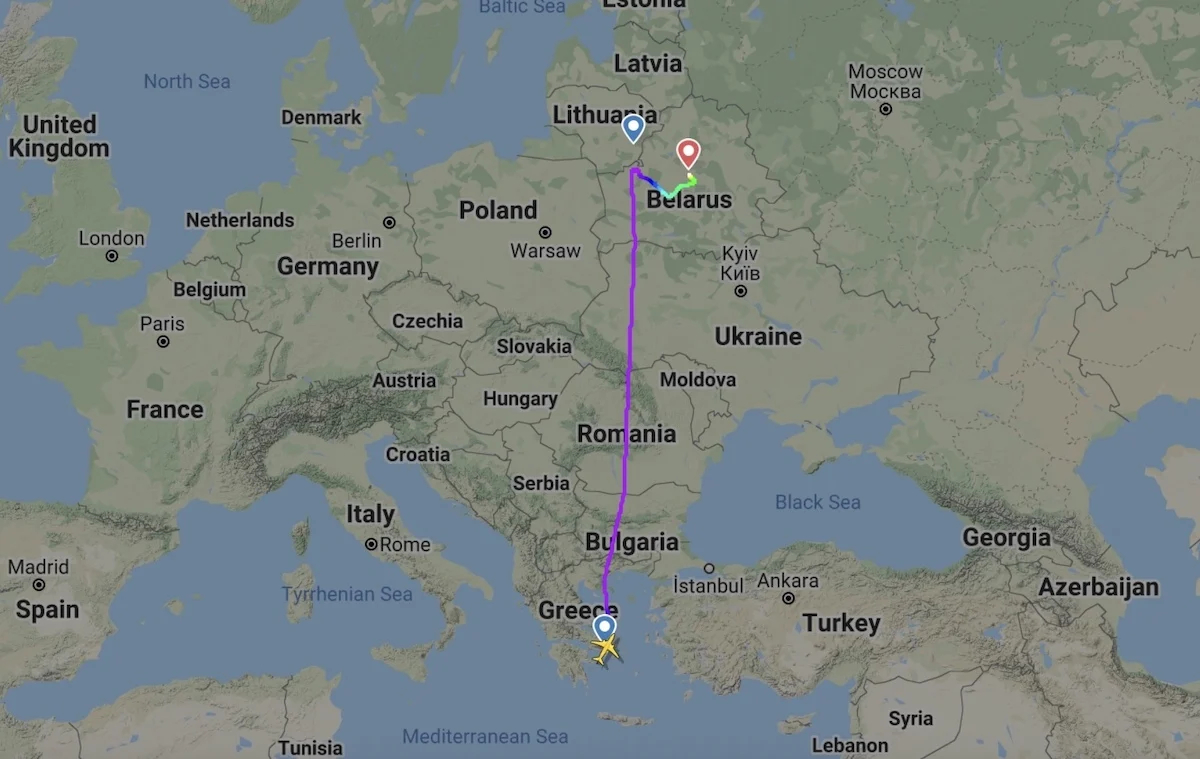
On 23 May 2021, Belarus forced a Ryanair flight, FR 4978, bound for Lithuania to divert to Minsk, accompanied by a fighter jet, to arrest dissident journalist Roman Protasevich. The plane had taken off from Athens and was en route to Vilnius when, just before entering Lithuanian airspace, it was ordered to land in Minsk. The crew was informed of a potential security threat and complied with the order, with a Belarusian warplane escorting the flight. However, no explosives were found on board. Instead, Protasevich and his girlfriend were removed from the plane and arrested.
Protasevich, a well-known Belarusian opposition journalist, founded the NEXTA blog and Telegram channel, which played a pivotal role in organizing anti-government protests last year. Belarus’s authoritarian leader, Alexander Lukashenko, is believed to have personally ordered the operation as his government faces growing opposition following disputed elections.
Ryanair’s CEO, Michael O’Leary, condemned the action as “state-sponsored hijacking” in an interview with the Irish independent radio station Newstalk on 24 May 2021. The forced diversion has sparked widespread international criticism of Lukashenko’s regime.
Newstalk: Can I start by asking you if your flight that was intercepted going from Greece to Lithuania intercepted over Belarus—your reaction to that? This must be the first time this has ever happened to a Ryanair flight
Michael O’Leary: I think it’s the first time it’s happened to a European airline, but I mean, this was a case of state-sponsored hijacking, state-sponsored piracy. But unfortunately, I can’t say much about it because the EU authorities and NATO are dealing with it at the moment. We’re debriefing the crews. our crews did a phenomenal job to get that aircraft and almost all the passengers out of Minsk after six hours, but we have to do a detailed debrief today with the NATO and EU authorities
Newstalk: I understand you’re restricting what you can say. it must have been very stressful for everybody, but particularly I presume for your staff—the pilots and crew—because it must have been very frightening for them
O’Leary: I think it was very fighting for the crew for the passengers who were held under armed guard had their bags searched .when it was clear, it appears that the intent of the Russian authorities was to remove a journalist and his traveling companion. You know we believe there were also some KGB agents offloaded off the aircraft as well.
Newstalk: So your understanding is that where agents on board as well. Will it change your plans in terms of flying over Belarus? Will you make any changes to your schedules? What do you think?
O’Leary: Like all the European airlines, I think we are looking for guidance today from the European authorities and NATO. If we are directed, we’ve asked them should we fly around Belorussia. We don’t fly over Belorussia much, and it would be a very minor adjustment to stay fly over Poland on those routes and but we will take our lead from the European security and safety agencies.
The international community is still grappling with the fallout from this shocking event, which serves as a stark reminder of the need to remain vigilant against authoritarianism and protect the fundamental rights of all individuals, regardless of their political beliefs or affiliations.
While strong reactions from governments and airlines may not have a significant impact, implementing international sanctions effectively will prove challenging. The Economisthighlights a troubling reality: the EU’s weak response may lead Putin to believe he could take similar actions without facing consequences.
Melukote in Mandya district of Karnataka is a sacred Srivaishnava centre where the great saint Sri Ramanujacharya spent his early years after coming to Karnataka from the Chola country.
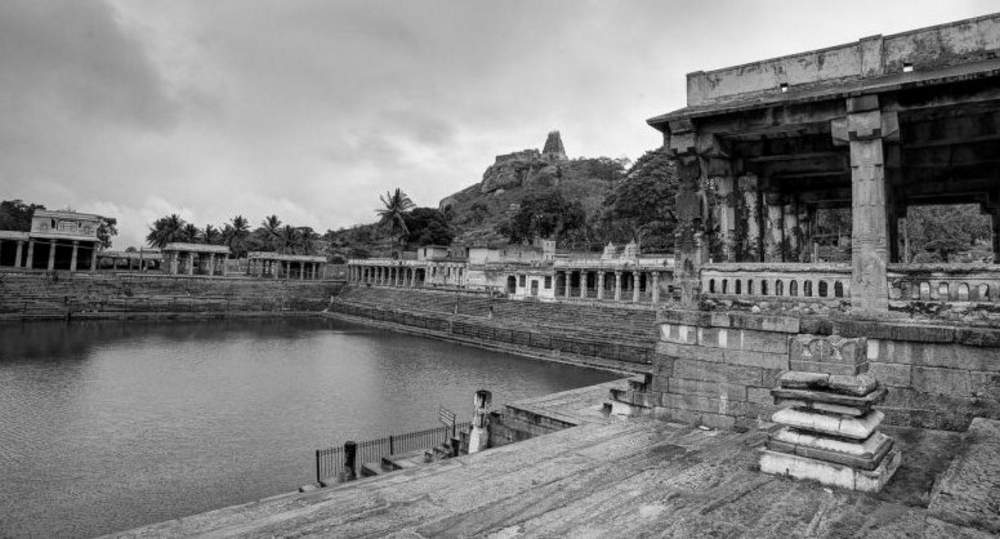
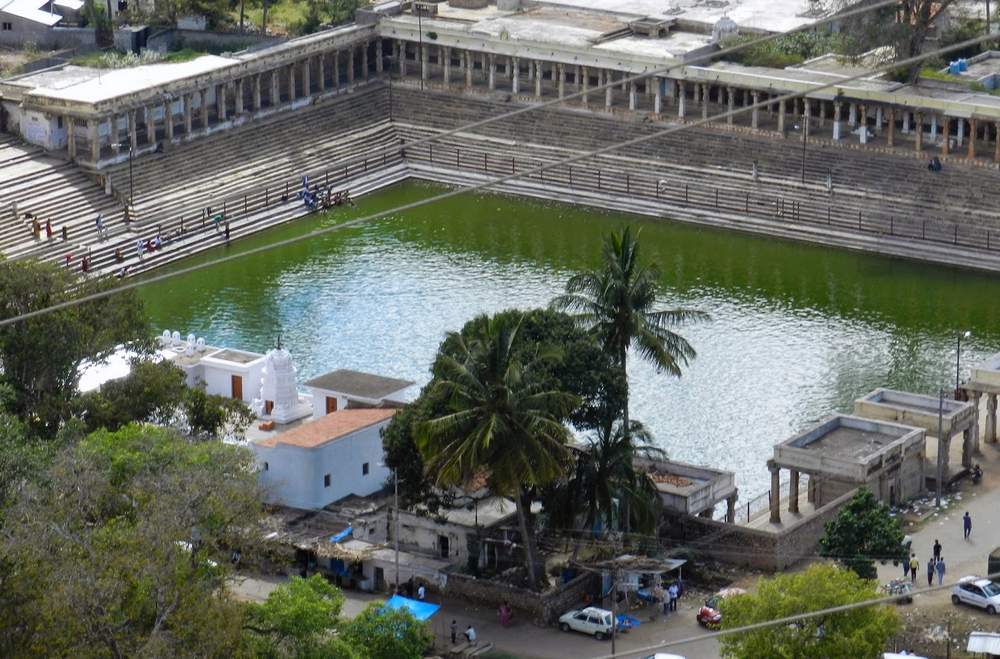
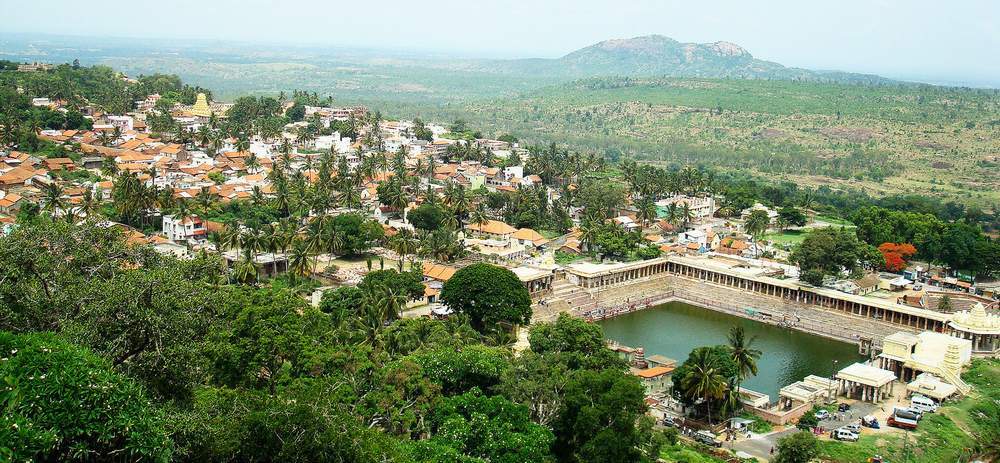
If a general view of Melukote is taken, two landmarks become most conspicuous by their location and they are the Narasimha hill and the Kalyani or the pushkarini. The beautiful holy water tank or the pushkarini is just at the western foot of the Narasimha hill. As a matter of fact, it is the main source of water supply to the entire town even today.
The pushkarini is considered sacred because of the belief that the great saint Sri Ramanujacharya used to take bath here when he was living at this place. Hence, a ritual dip in this pushkarini is considered sacred. Because of this sacred nature, a large number of minor shrines and mandapas were built around this tank in recent years, for the performance of various temple rituals and festivals.
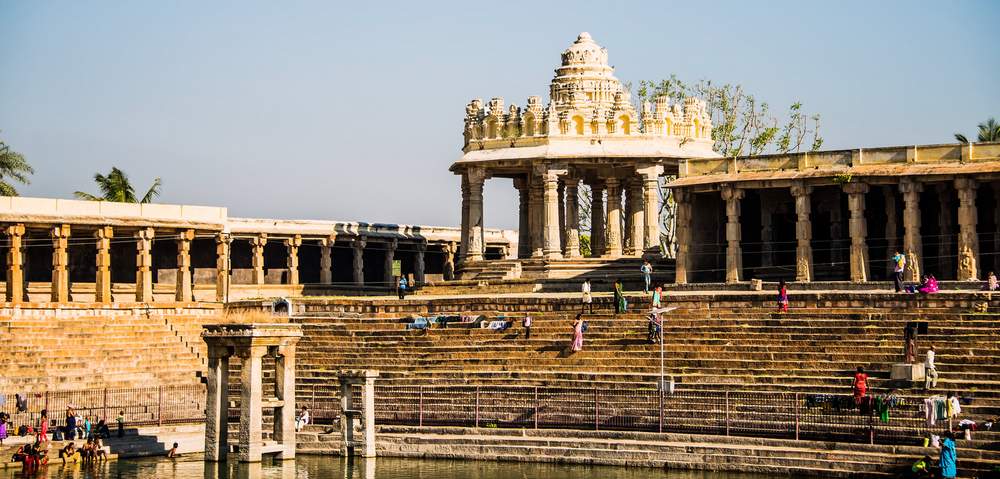
The pond itself is almost square each side measuring 300 ft. On all the four sides are neatly built stone steps leading to the water of the kalyani. Of all the mandapas and shrines that are built on the border of the pushkarini, the prominent place goes to the Bhuvaneshwari mandapa. It is an elegant octagonal structure built over eight tall and slender pillars. This is an open pavilion with a broad and crisp eave running all-round. Over this is a parapet with decorations and niches and it is surmounted by a stucco tower in the centre. This was constructed at the order of Krishnaraja Wadeyar III in the early part of the 19th century. Though small, it is very elegant and has added a rare charm to the pushkarini.
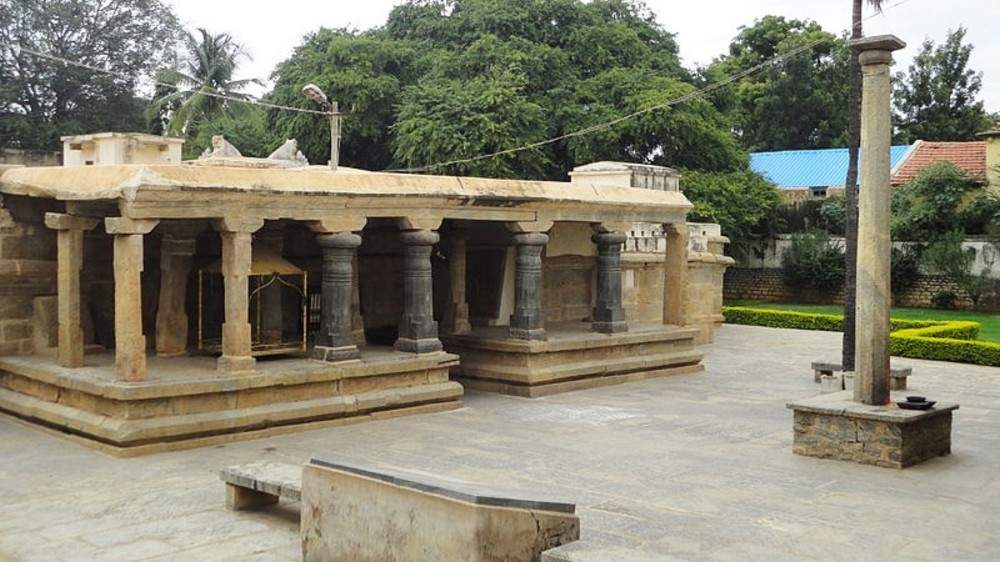
Ahobila matha on the northwestern corner has an image of Lakshminarasimha installed in the 19th century. To the east are two more mandapas by the side of a sacred pipal tree. To the western side is what is called Pancha Bhagavatha mandapa. On the northern side is a small cell wherein is placed Adishesha. Then there is another mandapa with over fifty pillars. Then there are four more mandapas where the kalyanotsava of the deity Narayana takes place.
Then there is a Nagavalli mandapa and a Varaha mandapa. By its side is the Bindu Madhava temple with a five feet image of the god holding sankha, chakra, gada and padma. The image seems to be of the Hoysala period.
The other structures are Parakala matha, Venkataramana temple, Kanchi matha and Rama temple. Thus, the pushkarini is not only beautiful but also has many mandapas where many rituals take place.
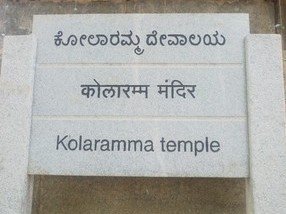
The Kolaramma temple in the town of Kolar is not only popular but also one of the big temples of that district.
Kolar is an ancient town known by various names such as Kolahalapura, Kuvalala, Kolala and finally Kolara. This name Kolahalapura is connected with puranic hero Parashurama. According to another tradition a cowherd boy by name Kola got a large amount of money by means of a treasure trove and goddess Renukadevi advised him to build a temple in the name of Kolaramma and he devotedly obeyed the goddess and built this temple. Apart from these traditions, this was the original capital of the Gangas before they moved to Talakad. Later it became a part of the Chola kingdom and after the defeat of the Cholas by the Hoysalas, it came under the Hoysala rulers. Finally, it became a part of the Vijayanagara empire.
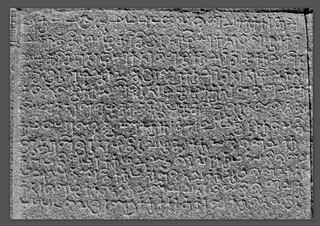
The Kolaramma temple is a Chola temple as evidenced by an inscription of 1033 CE. According to this inscription, the Kolaramma temple was built at the order of Rajendra Chola. His general Uttama Cholabrahmamarayan built this temple in stone, which was formerly a brick structure.
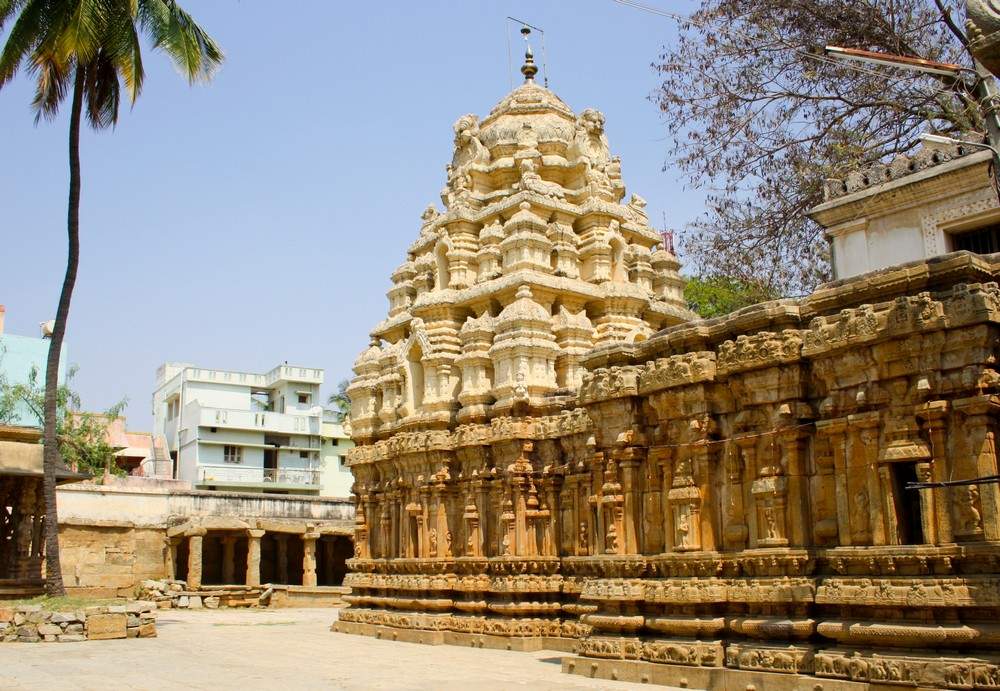
The Kolaramma Temple is built in the Dravidian or South Indian style; the pyramidal superstructure terminations in a curved roof over the sanctuary and the exterior pilastered walls with niches. The doorway is richly-carved with scrollwork and volutes encompassing mythological characters.
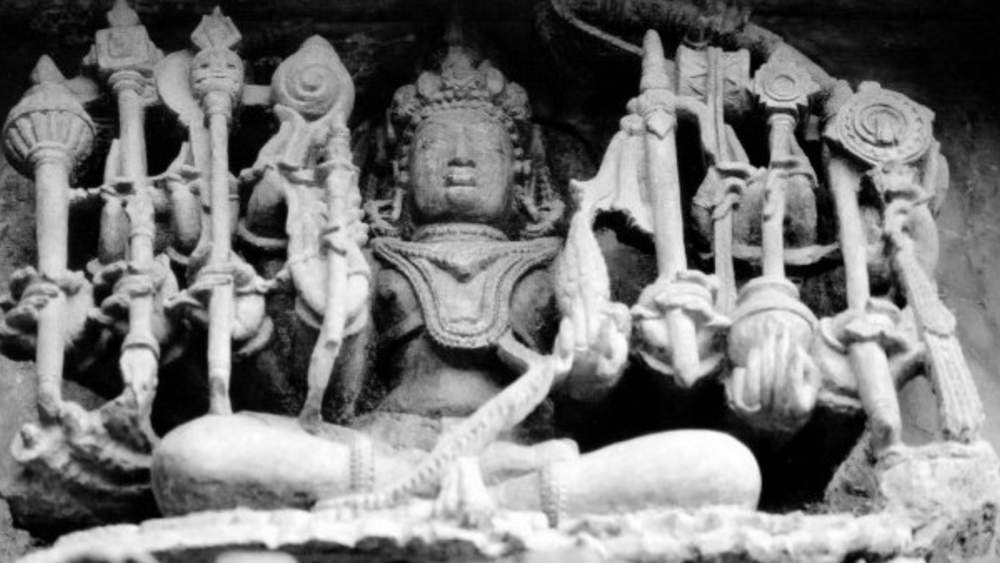
The ground plan of the temple is slightly unusual. It is a Dravidian temple. Its mahadvara has an imposing appearance and has well carved doorways. This is of the Vijayanagara period. In the centre of the prakara is the main garbhagriha. It has the images of Saptamatrikas (seven mothers) and an image of Kolaramma which actually is the image of Mahishamardini. She has eight hands holding different weapons and a demon under her feet. The fierce attitude of the sitting goddess is worth mentioning.
In another room, there are replicas of these images in mortar. It is believed that these mortar images were in worship originally before the stone ones came into use.
The goddess in the sanctuary was Mahishasuramardini, known as Kolaramma. This had replaced the original image of Kolarammma. The image has been replaced again by Saptamatrika figures.
There is another stone image of six feet in height called Kapalabhairava, locally referred to as Mukanancharamma. Some people believe that this was the original image of Kolaramma. However, this image is of great interest, as devotees believe that she will relieve them from the bite of the scorpion. Even today, people visit this temple for this purpose.
The temple is a center of Shakti veneration, a sect of ancient origins of the divine creative force of the Mother Goddess. Once a year people go to this temple and offer silver scorpion to this deity to ward off scorpion bite in future. The erstwhile maharajas of Mysore frequently visited this temple to get the blessings of Kolaramma. Thus, this ancient temple is interesting and important in the town of Kolar.
Much of life is dedicated to minimizing pain and maximizing ecstasy. We have become more and more sophisticated in our technology—we can live in space and map the human genome. Yet we have not been efficacious in our quest to culminate woefulness. Our age-old quandaries of prejudice, cruelty, and division persist, simply taking incipient forms over the centuries. With no exception everything will return to the Dharma Realm.”
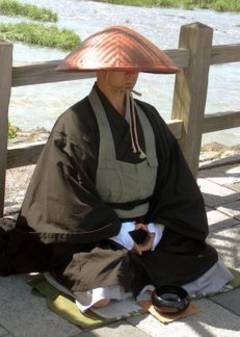
Everything is generated by the one and will eventually return to the one. Don’t misinterpret this and cerebrate that since you are not supposed to affix to relishes and disrelishes, you should consequently not cultivate the Way. In addition, when you visually examine Zen monks walk, it’s very fascinating. They have a different kind of walk from everybody else in Japan. Most Japanese shuffle along, or if they wear Western habiliments, they race and hurry as we do.
Zen monks have a peculiar swing when they ambulate, and you have the feeling they ambulate rather the same way as a feline. There’s something about it that isn’t hesitant; they’re going along all right, they’re not remotely senescent around, but they’re ambulating just to ambulate. The reason for this is that it has never been separate from us.
Zen Koan: “The Thief Who Became a Disciple” Parable
One evening as Shichiri Kojun was reciting sutras a thief with a sharp sword entered, demanding wither his money or his life.
Shichiri told him: “Do not disturb me. You can find the money in that drawer.” Then he resumed his recitation.
A little while afterwards he stopped and called: “Don’t take it all. I need some to pay taxes with tomorrow.”
The intruder gathered up most of the money and started to leave. “Thank a person when you receive a gift,” Shichiri added. The man thanked him and made off.
A few days afterwards the fellow was caught and confessed, among others, the offense against Shichiri. When Shichiri was called as a witness he said: “This man is no thief, at least as far as I am concerned. I gave him the money and he thanked me for it.”
After he had finished his prison term, the man went to Shichiri and became his disciple.
Buddhist Insight on Cultivating Mindfulness
In Buddhism, one can find all the necessary advice, which can help one to lead a happy married life. Cultivating mindfulness can help craving verbal expressions to realize their meaning. You can sit up straight for hours when the breath is open and you’re concentrated. See if this practice makes your mind more alert throughout the day. In Zen Buddhism, an image that’s used is of these burdens or difficulties being the same as a poisoned tree. The Vietnamese Buddhist monk Thich Nhat Hanh writes in Creating True Peace: Ending Conflict in Yourself, Your Family, Your Community and the World,
When you are in pain, remember to bring your mind back to your Buddha nature, your goodness and capacity for mindfulness, calm, and seeing deeply into the situation. If you allow yourself to be dominated by negative emotions, you will react in ways that will cause more suffering. You will want to punish the other person and say unkind things. We have all done this many, many times. To break out of this habit of suffering, this trap, we have to remember to practice mindfulness, to touch our Buddha nature. … We all have negative emotions and we also have Buddha nature within us, and it is possible for them to coexist in peace. The practice is to recognize our Buddha nature without running away from them. With mindfulness we can, maintain our peace, our stability, and our compassion in every moment and in every circumstance.
According to Zen Buddhism, the only source of energy that can be subsidiary is commiseration, for the reason that it is safe. When you have commiseration, your energy is born from insight. It is not visually impaired energy. With commiseration, we practice in order to learn ways to bulwark the lives of people, animals, plants, and minerals. You will feel restless and think, “Today has gone by already and I’ve wasted my time.”
Some people have this attitude when, after a day or two, they feel they have not made any progress. Another case was a person who was required to take the English equivalency exam in order to apply for a U.S. You cannot practice this way. Once we see how we are hooked and how we are swept along by the momentum, there’s no way to be arrogant. The trick is to keep seeing. On the contrary, they are unable to practice. The master looked out of his hut and saw a man about to cross the river.
Can a Buddhist monk have a family? A true totality would not even be considered “one”; it can only be called “nothing.” It is only when a distinction is made that the one can subsist at all, and in that cases it will lead to two. They often make the mistake of exerting physical energy to fight against wandering thoughts.
Zen Koan: “Zen in a Beggar’s Life” Parable
Tosui was a well-known Zen teacher of his time. He had lived in several temples and taught in various provinces.
The last temple he visited accumulated so many adherents that Tosui told them he was going to quit the lecture business entirely. He advised them to disperse and to go wherever they desired. After that no one could find any trace of him.
Three years later one of his disciples discovered him living with some beggars under a bridge in Kyoto. He at one implored Tosui to teach him.
“If you can do as I do for even a couple of days, I might,” Tosui replied.
So the former disciple dressed as a beggar and spent a day with Tosui. The following day one of the beggars died. Tosui and his pupil carried the body off at midnight and buried it on a mountainside. After that they returned to their shelter under the bridge.
Tosui slept soundly the remainder of the night, but the disciple could not sleep. When morning came Tosui said: “We do not have to beg food today. Our dead friend has left some over there.” But the disciple was unable to eat a single bite of it.
“I have said you could not do as I,” concluded Tosui. “Get out of here and do not bother me again.”
Buddhist Insight on Buddha Nature
Transgressions are classified either depending on the essence or on time. In addition, it happened that the Buddha came along the road as he was waiting thus. He thought it was just a conventional ascetic, and he meant to kill Him and get the hundredth finger he wanted. That is Buddha Nature. What probably happens is that his mind flickers with incredible rapidity between the two ideas; the agony is still there but may be reduced to endurable dimensions. The American Zen and spirituality teacher Dennis Genpo Merzel wrote in The Path of the Human Being: Zen Teachings on the Bodhisattva Way,
True nature is Buddha nature, unfixed and able to adapt to any container, so we will all express Buddha nature differently. Every person is a unique container and what is appropriate in one bowl may not be appropriate in another bowl. Our lives, too, are made up of different containers. Your body-mind is one container, and your family is another. Your work and living situations are containers, and our Earth is a container. For each situation a different manifestation is appropriate. Practice is all about learning how to recognize and manifest our true nature in everything we do. To become confident, free and joyful in manifesting our true nature takes a lot of attention and practice. Zazen is the way we accomplish this. Through zazen, we learn how to be who we really are.
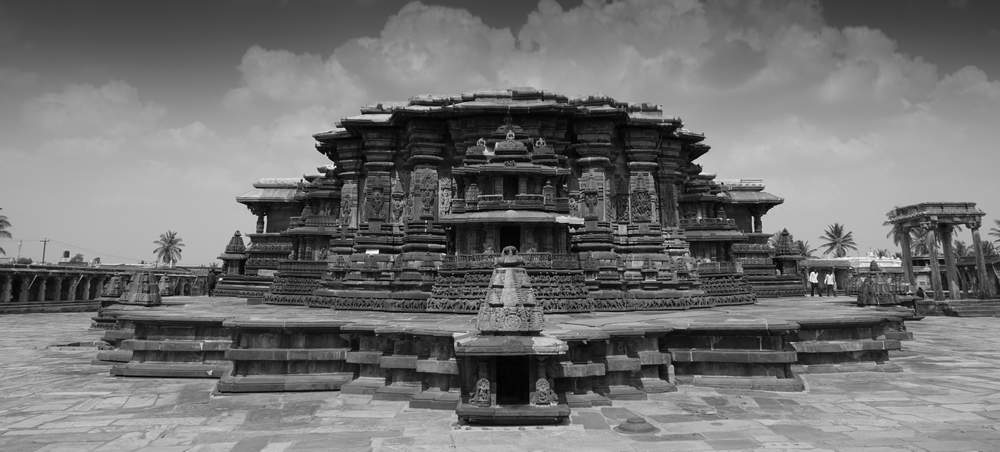
The Chennakeshava temple at Belur is perhaps the best specimen of Hoysala architecture and sculpture. The place was known as Velapura or Velapuri.
Hoysala King Vishnuvardhana defeated the Cholas at Talakad and to commemorate this great event built many temples in 1117 CE, of which Chennakeshava temple at Belur is the most important and beautiful. The entire temple is built of soapstone and stands on a platform also of star shape of 32 angles.
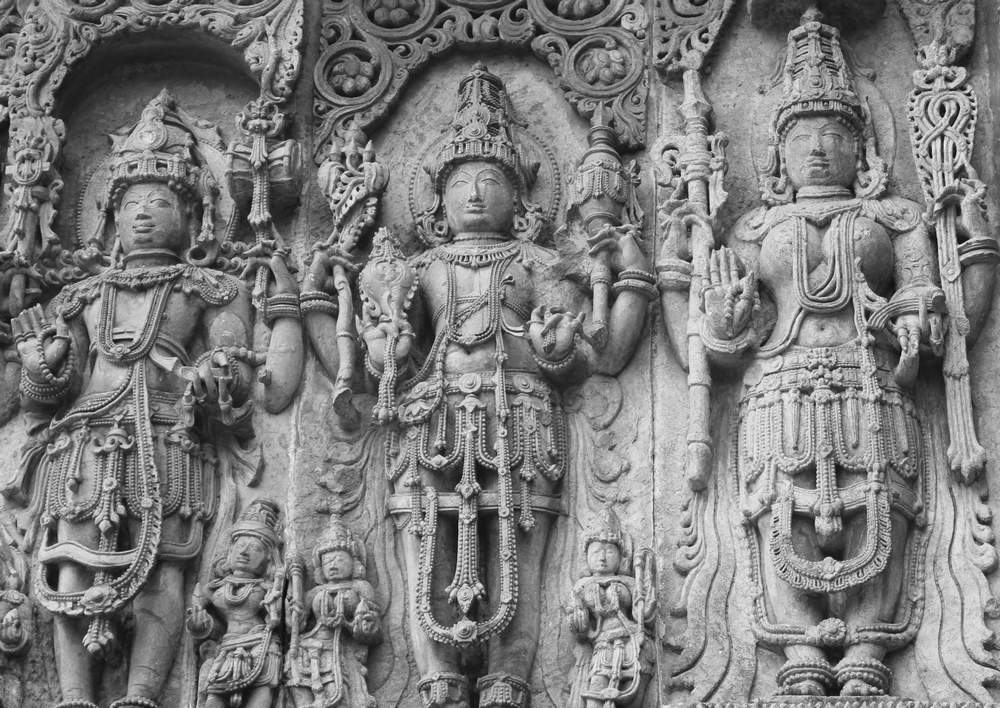
The outer wall of the temple from bottom onwards has tiers of minute sculptures consisting of rows of elephants, lion faces, creepers, ornamental frieze, dancers in small niches, female sculptures in between pillars, and the stories of Ramayana and Mahabharata. Above the friezes are wall sculptures of gods and goddesses in various poses under finely carved canopies. These sculptures are so varied and finely ornamented, it looks like an open air museum.
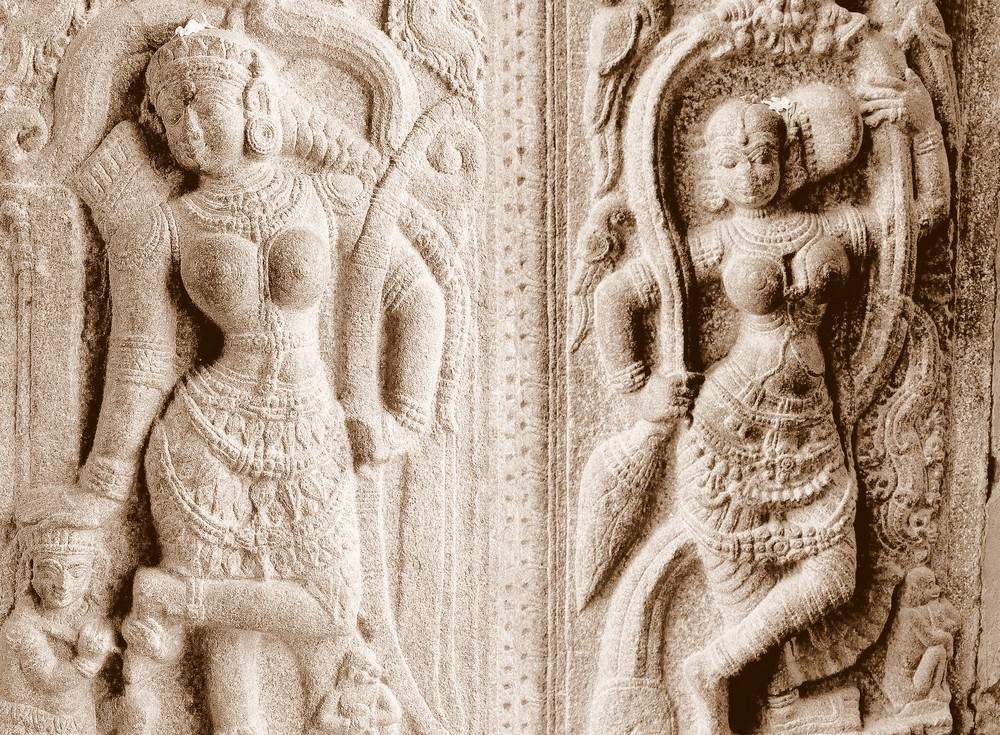
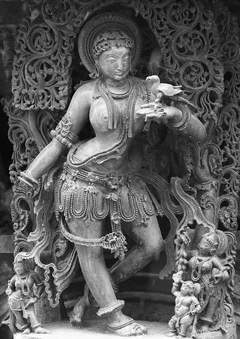
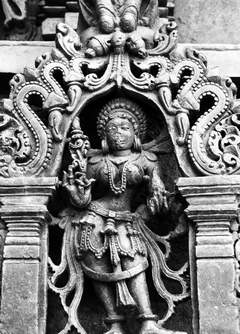
The ornamented windows called jalandhras which were added at a later date allow sufficient light and air to enter the interior of the temple. Over the sculptures and on the level of the roof are bracket figures known as silabalikas or madanikai sculptures. They represent beautiful damsels in various moods representing feminine charm and grace and perhaps these are the best creations of the Hoysala sculptors of the Belur temple. Vishnuvardhana’s queen Shantaladevi is associated with these sculptures.
The interior of the temple consisting of a garbhagriha, sukhanasi, navaranga and a mandapa takes us to a new world of sculptures with lathe turned pillars of various designs. One of the pillars known as Narasimha pillar could be turned on its axis. There are many delicately carved ceilings and they represent the best specimens of that type. The doorway of the garbhagriha is another specimen of delicate carvings unsurpassed for intricate designs.
Inside the garbhagriha is the sculpture of Chennakeshava or Vijayanarayana of about nine feet in height holding sankha, chakra, gada and padma in his hands, with a karanda makuta (crown) at the head. Bhudevi and Sridevi are standing at the bottom. Famous sculptors like Dasoja, his son Chavana, Nagoja, and others made this beautiful temple, the pride of Karnataka.
Besides this temple, the prakara has many more temples like Kappe Chennigaraya temple, Devi temple, and others with a mahadvara and a gopura.
Despair and anxiety can never be worked through until one confronts them in their stark and full reality. One can never apply some center from the outside. Difficult as the task is, we must accept ourselves and our society where we are, and find our ethical center through a deeper understanding of ourselves as well as through a courageous confronting of our historical situation. In this edification from the outset sitting in cogitation does not concern the mind nor does it concern purity. If you omit delusions, then the pristine nature reveals its purity. If you activate your mind to view purity without realizing that your own nature is pristinely pristine, delusions of purity will be engendered.
The ease of understanding was related to whether a koan was difficult or easy for a particular participant and also for the reason that some koans are designed to produce different effects on the student. It is not a five-star Hotel or the kind. If you have faith in the mind of equanimity and non-distinction, you have faith in no mind. When you grasp onto something, find a blissful medium. However, if there is no such duality, then there is no oneness to speak of either. Do not discombobulate this with enlightenment.
Zen Koan: “The Dead Man’s Answer” Parable
When Mamiya, who later became a well-known preacher, went to a teacher for personal guidance, he was asked to explain the sound of one hand.
Mamiya concentrated upon what the sound of one hand might be. “You are not working hard enough,” his teacher told him. “You are too attached to food, wealth, things, and that sound. It would be better if you died. That would solve the problem.”
The next time Mamiya appeared before his teacher he was again asked what he had to show regarding the sound of one hand. Mamiya at once fell over as if he were dead.
“You are dead all right,” observed the teacher, “But how about that sound?”
“I haven’t solved that yet,” replied Mamiya, looking up.
“Dead men do not speak,” said the teacher. “Get out!”
To breathe in mindfully is to be aware that air is entering our body, and to breathe out mindfully is to know that air is leaving our body. The moment our mind is attentive to the contact between our body and the air, we are also in contact with our mind, just as it is. It takes only one conscious breath to be in touch with ourselves and the world around us. Then, with each mindful breath, ease is restored to our body and mind.
Our struggle is obligatory, but it is eventually just our inclination to be present that counts and that this is the true effort of the way. Glad to know that you have time to meditate. In a country like America, where people can do so many things, and where there are so many distractions, to meditate is not easy. One gets older doing this and that, finding no real satisfaction in anything. Coming to accept that there is nothing wrong with me has been a very important part of growing up.
How can one be certain that there was a Teacher known as the Buddha? We present everything to the object of our surrendering. The basic act of surrender does not involve the worship of an external power. Rather it means working together with inspiration, so that one becomes an open vessel into which knowledge can be poured. You may feel liberated. If you do this, you are grasping the false. For instance, suppose you endeavor to clear a blocked pipe by pushing another object into it.
You can see the tip of each blade of grass and the outline of every leaf. The person who is seeking to attain is separate from the attainment, the object of his search. All of your actions will boomerang back to you and you will have to take the consequences.
Zen Koan: “Joshu’s Zen” Parable
Joshu began the study of Zen when he was sixty years old and continued until he was eighty, when he realized Zen.
He taught from the age of eighty until he was one hundred and twenty.
A student once asked him: “If I haven’t anything in my mind, what shall I do?”
Joshu replied: “Throw it out.”
“But if I haven’t anything, how can I throw it out?” continued the questioner.
“Well,” said Joshu, “then carry it out.”
Buddhist Insight on Being With Disappointment
Wisdom is also this development of patience, love, or constancy that you go through so many cycles. Unfortunately, the truth dealt with by science is only a partial one. By looking for complexities of developing and perfecting within the primordial unstructured presence of the nature and disenchantment, the essence without accepting and rejecting will not be seen. The American Zen teacher Charlotte Joko Beck writes in Nothing Special: Living Zen,
When we refuse to work with our disappointment, we break the Precepts: rather than experience the disappointment, we resort to anger, greed, gossip, criticism. Yet it’s the moment of being that disappointment which is fruitful; and, if we are not willing to do that, at least we should notice that we are not willing. The moment of disappointment in life is an incomparable gift that we receive many times a day if we’re alert. This gift is always present in anyone’s life, the moment when “It’s not the way I want it.”