How to Prepare Yourself for Future Opportunities

How to Prepare Yourself for Future Opportunities

Chance favors the prepared mind. “The prepared mind” is the characteristic of leaders who are outstanding in their talent to perceive, make sense, decide and act across a complex set of conditions. We also believe that “the prepared mind” is not a matter of chance. It is a matter of intentional preparation that requires developing eight mental skills regardless of your role.

How will you prepare for your tomorrow?

  1. You need the skill of observing because your world is more competitive. Execution-driven leaders often become so consumed by the pressures of running their projects and their organizations that they never pause to take a look at what’s going on around them. You may have mastered the core capabilities of your profession, and yet new technology might make these capabilities obsolete. List the capabilities you need to develop. Find a meaningful unifying purpose.
  2. You need the skill of reasoning because you need to reevaluate your assumptions. Data are useless without the skills to analyze them, reason, and make meaning of them. For example, are you thinking big enough? Take your situation and think bigger. Reasoning can complement problem-solving skills that you already have with a methodical approach to use with moral, ethical, organizational, or technical problems.
  3. You need the skill of imagining because you need alternatives to keep yourself sharp. Imagination is not a trait that we inherit in our genes or a blessing bestowed by the angels. It’s a skill. Be curious about everything—the world is full of amazing wonders for you to learn about. Creativity is at the heart of innovation. To improve this skill, list three combinations that would create something new and useful for you. Name one thing that you think you are too old to start. Are you really too old?
  4. You need the skill of challenging because expertise breeds conservatism. Challenging a group’s willingness to go with the first right answer can be major barrier to unleashing full creative potential. To improve the skill of challenging, list the constraints imposed on you. Who has already dealt with them? What did they do? What could you do?
  5. You need the skill of learning because new opportunities abound. Improved learning skills—concentrating, reading, and listening, remembering, using time, and more—are directly useful and will continue to pay dividends for a long time. What don’t you know that you should? List technologies, practices, or events that might provide insight. Learn about the future by studying some history. Also, list some mistakes or failures from your past. What did you learn from them?
  6. You need the skill of deciding because every decision has consequences, and no decision is a decision. Every solution brings about its own set of new problems. No leader knows enough about the future to make the most favorable decision every time, but it’s better to set a clear direction today and confront problems that crop up tomorrow. It’s not being afraid to fail; and if you do, identify it quickly and more ahead fast so no momentum is lost.
  7. You need the skill of enabling because all of us are smarter than any one of us, and “they” need the knowledge, means, and opportunity to help you reach your goals. Who needs your help, and how can they help you? Provide opportunities—delegate. Ensure that outcomes, actions and questions are properly recorded and actioned, and appropriately dealt with afterwards.
  8. You need the skill of reflecting because you learn more from understanding the reasons for your success and failure than you do from studying someone else’s best practices. Take a current problem and list possible answers. Now think like a beginner by asking dumb questions. Reflect on those questions and answers. The greatest strength of reflective leaders is their thoughtful and attentive nature, which means tremendous persistence to listen and take in information, the ability to connect the dots and garner eye-opening insights, and deep trust in their instinct, creativity, and thinking process.

Many leaders seem so besieged with their current workload that telling they prepare for the future may seem unreasonable. By preparing today to meet tomorrow’s challenges, they can set in motion a new leadership paradigm, one that will help leaders better cope with today.

Prepare your mind and then use your mind wisely. Leaders who focus on those eight basics will be prepared to encounter the unknowable challenges that lie ahead.

Books on Science Recommended by Investor Mohnish Pabrai (Pabrai Funds)

Mohnish Pabrai is an investor, hedge-fund manager and philanthropist. Mohnish manages Pabrai Funds and leads the Dakshana Foundation, a tutoring service in India for less-privileged members of the society to enable them to attend the elite institutions of higher learning in India.

Nine Elements of Organizational Performance

  • Motivation: Inspiring and encouraging employees to perform and stay
  • Coordination and Control: Measuring and evaluating business performance and risk
  • Innovation: Generating a flow of ideas so that the organization is able to adapt
  • Leadership Team: Ensuring leaders shape and inspire the actions of others to drive better performance
  • Direction: Articulating where the organization is heading and how to get there, and aligning people
  • External Orientation: Engaging in constant two-way interactions with customers, suppliers, or other partners
  • Work Environment and Values: Shaping employee interactions and fostering a shared understanding of values
  • Capabilities: Ensuring internal skills and talent to support strategy and create competitive advantage
  • Accountability: Designing structures/reporting relationships and evaluating individual performance to ensure accountability and responsibility for business results

Charlie Munger on Three Considerations that Average Investors can Use for Better Returns

In a lunch that investor Mohnish Pabrai of Pabrai Funds had with Charlie Munger, Berkshire Hathaway’s Vice-Chairman and partner of Warren Buffett, Charlie explained that an investment operation that focuses on three attributes would do exceedingly well.

  1. Carefully look at what the other great investors have done. Charlie endorses mirroring the investments of the most successful investors by learning from the 13Fs they might file. Look at what other great minds are doing.
  2. Look at the cannibals. Look thoroughly at the businesses that are buying back huge amounts of their stock. These businesses are eating themselves away, so Charlie describes them as the cannibals.
  3. Carefully study spinoffs. Joel Greenblatt of Gotham Capital has a whole book on spinoffs: “You Can Be a Stock Market Genius Too.” Overall the book discusses investment opportunities presented by circumstances that are usually not considered by the average investor: spin-offs, mergers, risk arbitrage, restructurings, rights offerings, bankruptcies, liquidations, and asset sales.

Charlie Munger believes that if an investor did just three things, the end results would be vastly better than the returns of an average investor.

Read this Motley Fool article on more of what Mohnish Pabrai learned from Warren Buffett and Charlie Munger.

Warren Buffett, the Mattress Salesman at Nebraska Furniture Mart

One of the traditions at the Berkshire Hathaway annual meetings is an hour-long light-hearted movie show. In fact, the “movie” is a collection of video clips some of which showcase commerials and skits from Berkshire Hathaway’s vast array of businesses, some featuring Buffett-comedy, surprise celebrity features, and so on, often to wild laughter among the crowd.

In 2013, the Berkshire Hathaway video started with a cartoon version of Dancing with the Stars with Warren Buffett and partner Charlie Munger as judges. After the judges dismissed every contestant, including Dairy Queen and the Geico Gecko, the judges themselves won the contest by dancing to the Gangnam Style. The 2013 movie also had clips of Warren Buffett and Fortune Magazine’s Carol Loomis appearing on the Daily Show with Jon Stewart to promote “Tap Dancing to Work: Warren Buffett on Practically Everything”. A humorous debate over “ketchup” vs. “catsup” from the sitcom King of Queens highlighted Berkshire Hathaway’s buyout of H.J. Heinz Company (in partnership with Brazil’s 3G Capital.)

In recent years, the “movie” has also featured Warren Buffett’s opening statement to a Committee of the U.S. House of Representatives on the Salomon Saga. “Lose money for the firm, and I will be understanding; lose a shred of reputation for the firm, and I will be ruthless,” warns Mr. Buffett at the end of that opening statement.

The security staff at the Berkshire Hathaway meetings forbid attendees from recording audio or video from the opening movie due to confidentiality and copyright restrictions. At the beginning of the movie, a voice-over or video recording from Warren Buffett assures appearances from “a number of people you recognize” and reminds that the celebrities work for free, at the request of the notoriously stingy Buffett. “Surprise, surprise.”

Over the years, the most popular clips in the movie feature a hilarious Warren Buffett attempting at diverse jobs in Berkshire’s businesses. Here’s one from Berkshire’s furniture business, Nebraska Furniture Mart.

The Warren and Charlie Show at Berkshire Hathaway’s Annual Meetings

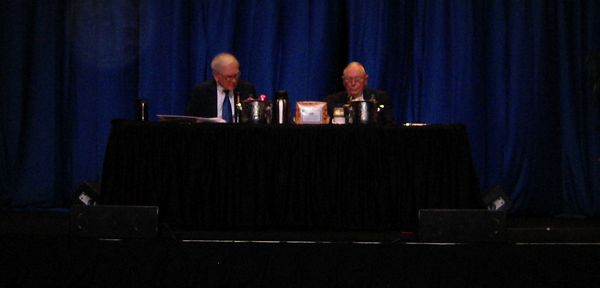
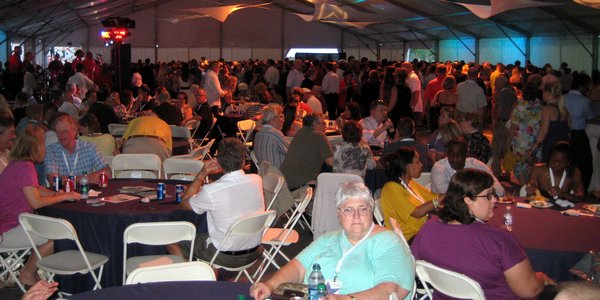
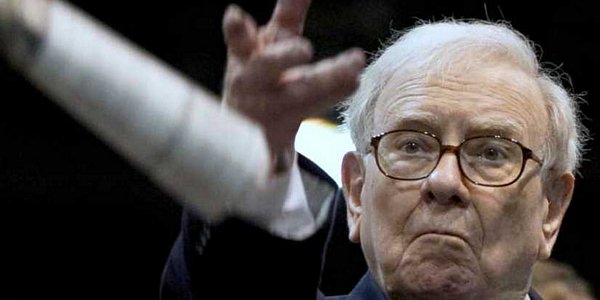
At the Berkshire Hathaway annual shareholders meetings in Omaha, Warren Buffet and Charlie Munger sit at the center of the stage in front of a dark sea of shareholders. Warren Buffet first fields questions from the audience and a panel of journalists and stock analysts. Warren answers them and will ramble on a bit in his unique way (often with a one-liner or two mixed in) for a few minutes.

Then, Warren will look over to his partner and query, “Charlie?” Then Charlie Munger will either lean in and make a sharp, critical, pithy, often derisive comment (which usually extracts gasps or loud chuckles from the audience) or simply remark, “I have nothing to say,” which can be entertaining particularly after a long-winded digression from Warren Buffett.

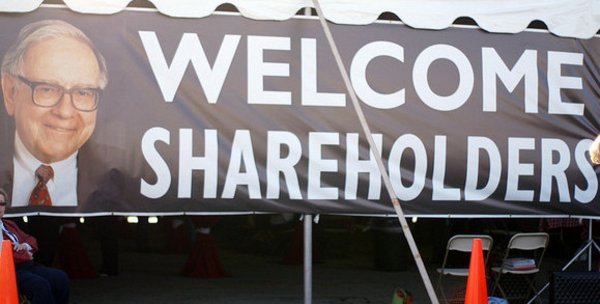
Berkshire Hathaway annual shareholders meetings are normally held on the first Saturday of May in Omaha, Nebraska.

Recommended Reading

Conducting Behavioral Assessments: Advantages

Behavioral assessments ask specific questions focused on target behaviors. Behavioral assessments are interested in samples of behavior and not behavior as a sign of internal processes. The responses collected from behavioral assessments can be interpreted as samples of a person behavior that are thought to generalize to other situations that the person might be subject to.

Overall, data and information resulting from behavioral assessments may have numerous advantages over data and information derived by traditional assessments or other methods of assessments. Data derived from behavioral assessments can be used:

  • to present behavioral baseline data with which other behavioral data (gathered after the passage of time, after a particular intervention, or after some other event) can be compared
  • to make available a record of the subject’s behavioral strengths and weaknesses across a assortment of situations, circumstances, and settings that the subject can be exposed to
  • to identify and pin down environmental circumstances that act to trigger, maintain, or extinguish certain behaviors in the subject
  • to identify and target precise behavioral patterns in a subject for modification through clinical or psychological interventions
  • to produce graphic displays that can be used to encourage inventive methods of treatment or more effective clinical or psychological therapy methods

The level of training and the experience of assessors influence the validity and reliability of behavioral assessments. Also affecting the soundness of the behavioral interviews is the ability to generalize the observations to other subjects, settings, and situations.

The Best Tweets by Career Coach Marty Nemko: Life Lead Well & Career Success

Marty Nemko is an Oakland, CA-based career coach, and author. Marty hosts the “Work with Marty Nemko” on KALW-FM, an NPR-San Francisco station.

Marty Nemko blogs about career, education, men’s and boys’ issues, the life well-led, and improving the world at martynemko.blogspot.com/. A compilation of his articles and writings are at www.martynemko.com/. His YouTube channel is at www.youtube.com/user/mnemko.

Marty also published a compilation of his articles in newspapers, blogs, magazines, and on his website in book chock full of wisdom: ‘How to Do Life: What they didn’t teach you in school’.

Here are the very best of Marty Nemko’s tweets from his @MartyNemko handle.

  • “I even take care to tear-off single sheets of toilet paper. Because I’m cheap? No. Because it’ll help the environment? No. I just think wasting is wrong.”
  • “If you relentlessly pursue a big goal with laser-beam focus, you will likely like your life and be a most worthy person.”
  • “Where at all ethically possible, we must give others hope. Without it, a person figuratively or even literally dies.”
  • “Exploring what your parents did to you may provide insight but, often, your life is no better. It just legitimizes your malaise, maybe even increases your stuckness..”
  • “Facing our parents’ aging forces us to confront our own mortality. It reminds us to appreciate and live each moment wisely.”
  • “Keep it simple: Reasonable diets all distill to: Lots of vegetables and legumes, some fruit, and small portions of everything else.”
  • “Be kind where you can, tough where you should.”
  • “If you have a clearly good idea, to avoid getting talked out of it, get input only on how to better execute it.”
  • “As we age, we may accrue a creeping bitter wisdom.”
  • “Telling people I can’t lose weight may make me eat more—to prove myself right. Perhaps if I told people, “‘I’m gonna lose 20.'””
  • “There’s cost and benefit each time you criticize or suggest. Sometimes, it’s worth the price. Make the choice consciously.”
  • “That a partner ‘gets’ you, this is what above all cements love: love as accurate (but still benevolent) interpretation.”
  • “A desire to “give back” needn’t imply giving to the neediest. It could mean giving to those with the most potential to benefit.”
  • “We dun perfectionism, e.g., as causing procrastination. Yet haven’t your perfectionist efforts yielded the most good & satisfaction?”
  • “A mantra to cure procrastinators: It needn’t be perfect; it needn’t be fun; it just has to get done.”
  • “Far better than a course is self-study + a tutor to get you past your trouble spots.”
  • “Far more of life’s pleasures are in the process than in the outcome. Be in the moment.
  • “Whatever bad awaits, don’t let it spoil the present moment.”
  • “Scratch the surface of any thinking ideologue and you’ll find doubts. Ask, “Ever wondered whether the other side might be right?””
  • “Might you be wise to focus more on self-acceptance than self-improvement? That might even motivate you to self-improve.”
  • “More than a little “processing” of past bad experiences is often counterproductive.”
  • “No matter how brilliant you are, if your style is too intense, most people will dismiss you.”
  • “It’s easy to be liked: listen more than talk, praise often, and disagree rarely. The question is, is it worth the loss of integrity? “
  • “Long-winded? Constantly ask yourself, “Does the person really need & want to know this phrase?” And keep utterances to <30 sec.”
  • “I used to think most people are intrinsically motivated to work hard. But I’m finding that many if not most people need monitoring.”
  • “The key to a well-led life is maxing your contribution. Happiness, less key, is most likely found in simple pleasures.”
  • “How feeble are we that we’re swayed more by dubious flattery than by valid suggestions.”
  • “Key to being liked: While retaining integrity, do more agreeing, amplifying, empathizing. do less arguing, one-upping, yes-butting.”
  • “Why do so many people prefer a silly, manipulative, games-playing, selfish hottie over an ugly, intense, honest, kind person?”
  • “It all comes down to this: Do good.
  • “You’ll likely learn more of enduring value from an hour of wise googling than from any course.”
  • “Part of getting older may mean having to accept that we may not make as big a difference in the world as we had hoped.”
  • “For many people, before age 60, it’s business before pleasure. After 60, pleasure before business.”
  • “To boost self-esteem: accept you’re flawed like everyone, do what you’re good at, & accomplish: Even little wins boost self-esteem.”
  • “A clue to what career or avocation you should pursue is to inventory how you actually spend your discretionary time.”
  • “If you’ve been beaten up in Rounds 1-9, it’s hard to come out for Round 10.”
  • “It’s hard to change people’s work style: aggressive vs passive, hardworking vs moderate. So it may be wise to praise their status-quo.”
  • “Many people can do well in school, even get PhDs, yet are unhireable in the real world. The degree is US’s most overrated product.”
  • “A resume rarely helps—it’s too filled with chemistry-inhibiting cliche. Write & tell the “resume” that’d reveal your true story & self.”
  • “Be tough where you must be, kind where you can be.”
  • “You can do everything right and still fail, not just once, but overall in life. Luck is more important than we acknowledge.”
  • “A clue to what career you should pursue: When you’re really comfortable, what do you love to talk about?”
  • “If you want to lock in a new attitude or behavior, say and/or write that and why. Then keep paraphrasing, NOT reading it.”
  • “Before making an argument, ask a likely opponent to lay out the counterargument. Your argument can then incorporate that.”
  • “In your desire to stand out from the horde, beware of hyping yourself, your ideas, or taking inappropriately extreme positions.”
  • “Giving advice makes the recipient feel less efficacious, so weigh that against the benefit your advice will likely yield.”
  • “Unefficacious people can’t or CHOOSE TO not bounce back—it’s a good excuse to avoid facing their inefficacy yet again.”
  • Teamwork is deified. Don’t forget the pluses of individualism: more motivation, bolder/less compromised solutions, speed.”
  • “When overwhelmed, after doing any needed planning, just stay in the moment and put one foot in front of the other.”
  • “If your self-esteem is low, perhaps focus on finding work you can succeed at. Real self-esteem comes from accomplishment.”
  • “If someone smiles at you with pursed lips, they’re generally forcing the smile—either because they’re shy or don’t like you.”
  • “Wasting money on designer labels is so 20th-century. It’s a permanent loss of money in exchange an evanescent feel-good.”
  • “Don’t confuse tact with cowardice. Sometimes, it’s wise to speak up boldly.”
  • “Talking too much is a career killer. Keep all utterances to less than 45 seconds &, in dialogue, speak a bit LESS than 50% of the time.”
  • “School can give a false sense of confidence or of loserhood. Too often, school success does not predict life success.”
  • “Your goal must not be to impress but to accomplish. That usually demands bringing out the best in others.
  • “Just because you CAN prove someone wrong, doesn’t mean you should.”
  • “I fear we’ll make everything equal until everyone has nothing.”
  • “To boost motivation: what’s your next 1-second task? It feels good to get even a tiny task done, make progress, and maybe learn something.”
  • “To disagree without creating enmity: “I can see why you’d X. (explain.) And (not but) I’m wondering if Y. What do you think?””
  • “In managing & parenting, praise when you can, & when you can’t, try invoking guilt, e.g., “I know you’re better than this.””
  • “The most powerful motivator may not be fear—people go back to bad habits after a heart attack. Could it be proving themselves right?”
  • “As we age, there’s a creeping bitter wisdom we accrue.”
  • “When you think you can nail someone with your argument, take a breath & see if you can phrase it as a face-saving question.”
  • “Some people are nice as a way of compensating for their not being good.”
  • “If possible, slightly under-schedule yourself. That gives you the time to make your work higher-quality.”
  • “Ever get tired of being nice? Tempted to throw caution to the wind and say what you really think? If deserved, even yell? “
  • “Winners do not let themselves succumb to anything. They distract themselves by immersing themselves in their most engaging work.”
  • “Good conversationalists choose a topic that enables each participant to contribute. “
  • “It worked for me, it can work for you books aren’t helpful because typical readers are less smart & driven than book authors.”
  • “To broaden your horizons, mix with people other than people from your own background (professional, cultural, social, academic, racial, ethnic, etc.) Most people prefer the company of other people from similar backgrounds. Birds of a feather do flock together.”
  • “Most of us think ourselves bold, individualistic thinkers when in fact we’re tepid if not downright lemmings.”
  • “Good, simple conversation starter, “What’s doing in your life?” or “Whatcha been thinking about these days?””
  • “What skill of yours has given you the must success? Use it more.”
  • “The most valuable way to spend a dollar? A memo pad. Keep it with you at all times. Think of ideas. Write them down. Implement them.”
  • “Successful, productive people fuel themselves with their work & accomplishment, unsuccessful people through recreation.”
  • “The desire to be right usually trumps the desire for truth.”
  • “The only God resides within us: It is our our wisest attitudes and actions.”
  • “We hear stories of persistence rewarded yet for each of those, hundreds have pressed on only to end up broken and/or broke.”
  • “If the risk/reward ratio of taking an action is good, even if you may fail, it’s usually wise to follow Nike’s advice: Just do it!”
  • “Sometimes, a problem has both a rational and an irrational component. It may help to try to solve those separately.”
  • “People see counselors when they could journal on their own. People take classes when they could read on their own. Why? They’re forced to act.”
  • “Don’t give up prematurely. Your continued efforts will iterate, improve based on lessons learned from your past failures.”

A Definitive Guide to Berkshire Hathaway’s 2014 Annual Shareholders Meeting

Value Investing Conference and Genius of Warren Buffett Course

Shareholder Events on 02-May-2014, Friday

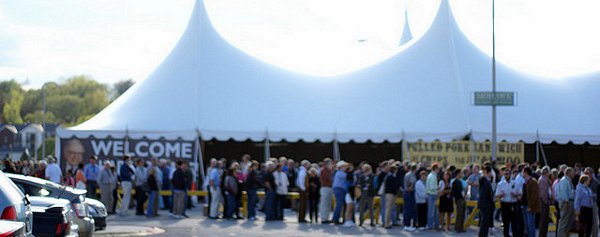
  • 6:00 PM to 9:00 PM: Cocktail Reception at Borsheim’s Fine Jewelry. Borsheim’s is Berkshire’s flagship jewelry retailer and the second biggest jewelry store in the world. This cocktail reception is exceptionally crowded. And Borsheim’s also sets a tent in the parking lot to accommodate the swarms of people enjoying the dinner buffet, open bar, and live musical entertainment, all complimentary. Vegetarians can get their fill of broccoli, cauliflower, carrots, and crackers. Location: Borsheim’s, 120 Regency Parkway, Omaha NE 68114 [map], (800) 642-4438.

Shareholder Events on 03-May-2014, Saturday

  • 7:00 AM: Doors Open at CenturyLink Center for the annual meeting. Shareholders, young and old, assemble hours before the opening of the doors to the CenturyLink center and, as soon as the doors are unlocked, run as quickly as they can to get the best seats in the house.
  • 7:00 AM: Complementary breakfast: free pastries and bottled drinks in the stands at CenturyLink Center.

  • 12:00 PM to 5:00 PM: NetJets Display. “Signature Flight Support” on the east side of the Omaha airport. Collect passes to the NetJets display at the NetJets stall in the shopping area. Shuttle busses leave the northwest corner of the CenturyLink Center. On display are a fleet of NetJets aircraft “sure to set your pulse racing. Warren urges, “Come by bus; leave by private jet. Live a little.”
  • 12:00 PM to 1:00 PM: Buy-your-own lunch at CenturyLink’s stands.
  • 3:30 PM to 3:45 PM: Recess / regrouping
  • 3:45 PM to 4:00 PM: “Official business” part of the Berkshire Hathaway annual shareholders meeting.

Shareholder Events on 04-May-2014, Sunday

  • 1:00 PM: Games at the Borsheim’s Shopping Day
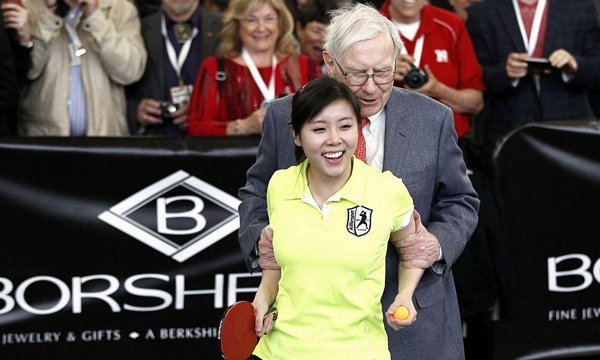
  1. Challenge U.S. Olympian Ariel Hsing at ping-pong / table tennis. At 1:00 PM, Bill Gates and Warren Buffet “will try to soften her up.”
  2. Two-time U.S. chess champion, Patrick Wolff, who will be blindfolded, will take on challengers in groups of six.
  3. Norman Beck, a remarkable magician from Dallas, will bewilder onlookers.
  4. Bob Hamman and Sharon Osberg, two of the world’s top bridge experts, will take on challengers at bridge, Warren’s favorite pastime. Warren warns, “Don’t play them for money.”
  • 1:00 PM to 10:00 PM: One of Warren’s favorite restaurants, Gorat’s is open exclusively for Berkshire shareholders. Warren has said he will eat both at Gorat’s and Piccolo’s. Location: 4917 Center St, Omaha, NE 68106 [map.] By reservations only. Call (402) 551-3733 on or after April 1-Apr-2014, Tuesday for reservations.
  • 4:00 PM to 10:00 PM: One of Warren’s favorite restaurants, Piccolo Pete’s Restaurant is open exclusively for Berkshire shareholders. Warren has said he will eat both at Gorat’s and Piccolo’s. Warren recommends getting giant root beer float for dessert. “Only sissies get the small one,” he provokes. Location: 2202 S. 20th Street Omaha NE 68108 [map.] For reservations, call 402-342-9038 anytime.
  • Throughout the Week: Shareholder Discounts and Shopping

    • At Borsheim’s Fine Jewelry, shareholder prices will be available from Monday 28-Apr-2014 through Saturday 10-May-2014. Borsheim’s is usually open 10:00 AM to 8:00 PM on Mondays and Thursday, 10:00 AM to 6:00 PM on Tuesdays, Wednesdays, and Fridays, and 10:00 AM to 5:30 PM on Saturdays. Borsheim’s is located at 120 Regency Parkway, Omaha NE 68114 [map]. Most of the items in Borsheim’s are discounted no less than 30% for Berkshire shareholders.
    • At Nebraska Furniture Mart (NFM,) shareholder prices will be available from Monday, April 28th through Saturday, May 10th. Nebraska Furniture Mart is located at 700 S 72nd St, Omaha NE 68114 [map]. NFM is open 10:00 AM to 9:00 PM Monday through Saturday and 10:00 AM to 6:00 PM on Sundays. Shareholder discounts are also available at Nebraska Furniture Mart’s stores in Kansas City and Des Moines (no furniture; just appliances, electronics, and flooring.)

    Getting Meeting Credentials

    Meeting credentials are required to enter the CenturyLink Center for the Berkshire Hathaway meeting or the adjoining area to hit the stores of the many Berkshire subsidiaries. Meeting credentials are also required to get special shareholder pricing at Borsheims, Nebraska Furniture Mart, and other stores that might offer shareholder discounts.

    Berkshire Hathaway meeting credentials are no more than a plastic identification card and an associated lanyard. The identification card is not personalized and does not contain the shareholder’s or attendee’s name.

    Here’s how to get your meeting credentials:

    • If you are a shareholder, your brokerage will send you the annual shareholders’ packet along with a postcard to request a maximum of four passes for the Berkshire annual meeting. Fill this postcard and drop it in the mail. Berkshire will send you passes and lanyards.
    • If you are a shareholder, but do not have time to request the passes, did not receive the passes, or did not receive the shareholder packet from your broker, take proof of your ownership of Berkshire Hathaway stock. Take a statement of your holdings from your broker to the annual meeting at the CenturyLink Center on the Friday afternoon or Saturday morning of the annual meeting to get your meeting credentials.
    • Many years ago, Berkshire Hathaway shareholders started auctioning the annual meeting passes on eBay for a premium. To hinder this premium, Berkshire Hathaway started directly selling two passes for $5 on eBay, with free shipping. “We decided to sell them ourselves on EBay at a nominal price to keep people from getting stung. We hope nobody pays more than what we charge which is basically to cover mailing charges,” a Berkshire Hathaway representative had informed Omaha World-Herald. Buyers could provide a mailing address when you checkout or just collect their passes from the CenturyLink Center on the Friday afternoon or Saturday morning of the Berkshire meeting.
    • If you are straining at the leash to go to the annual meeting and don’t have passes, just show up early on Saturday morning at the CenturyLink Center. I have seen shareholders in the line obliging to requests for passes from devoted fans of Berkshire; this practice needs to be discouraged.

    Recommended Reading: “The Oracle & Omaha, How Warren Buffet and His Hometown Shaped Each Other”

    ‘The Oracle & Omaha, How Warren Buffet and His Hometown Shaped Each Other’ by Steve Jordon, Omaha World Herald

    Warren Buffett in 1951: “The Security I Like Best:” GEICO

    In his 2013 annual letter to Berkshire Hathaway Shareholders, Warren Buffet extols his mentor Ben Graham’s discourse on value investing, “The Intelligent Investor.” Warren has previously described The Intelligent Investor as “by far the best book on investing ever written.”

    I learned most of the thoughts in this investment discussion from Ben’s book The Intelligent Investor, which I bought in 1949. My financial life changed with that purchase.

    And:

    A couple of interesting sidelights about the book: Later editions included a postscript describing an unnamed investment that was a bonanza for Ben. Ben made the purchase in 1948 when he was writing the first edition and—brace yourself—the mystery company was GEICO. If Ben had not recognized the special qualities of GEICO when it was still in its infancy, my future and Berkshire’s would have been far different.

    And,

    When I was first introduced to GEICO in January 1951, I was blown away by the huge cost advantage the company enjoyed compared to the expenses borne by the giants of the industry. That operational efficiency continues today and is an all-important asset. No one likes to buy auto insurance. But almost everyone likes to drive. The insurance needed is a major expenditure for most families. Savings matter to them—and only a low-cost operation can deliver these.

    Warren Buffett’s 1951 Analysis Article: “The Security I Like Best”: GEICO

    In the 06-Dec-1961 (Thursday) edition of The Commercial and Financial Chronicle, a weekly business newspaper in the United States, Warren Buffett published an article on his analysis of the GEICO stock. He described GEICO, Government Employees Insurance Company, as the “The Security I Like Best.” Warren E. Buffett was then the principal of Omaha, NE, Buffett-Falk & Co. Below is a copy of Warren’s article; a facsimile of the article is also available in the PDF format: Warren_Buffett_-_The_Security_I_Like_Best.pdf.

    This article is educational because it clearly shows the considerations that Buffett used to probe the company and evaluate its stock. The way of thinking of how Buffett and Berkshire Hathaway came to own GEICO provides a pattern of how to find and research any investment.

    The Security I Like Best: The Government Employees Insurance Co. (GEICO)

    Full employment, boom time profits and record dividend payments do not set the stage for depressed security prices. Most industries have been riding this wave of prosperity during the past five years with few ripples to disturb the tide.

    The auto insurance business has not shared in the boom. After the staggering losses of the immediate postwar period, the situation began to right itself in 1949. In 1950, stock casualty companies again took it on the chin with underwriting experience the second worst in 15 years. The recent earnings reports of casualty companies, particularly those with the bulk of writings in auto lines, have diverted bull market enthusiasm from their stocks. On the basis of normal earning power and asset factors, many of these stocks appear undervalued.

    The nature of the industry is such as to ease cyclical bumps. The majority of purchasers regards auto insurance as a necessity. Contracts must be renewed yearly at rates based upon experience. The lag of rates behind costs, although detrimental in a period of rising prices as has characterized the 1945-1951 period, should prove beneficial if deflationary forces should be set in action.

    Other industry advantages include lack of inventory, collection, labor and raw material problems. The hazard of product obsolescence and related equipment obsolescence is also absent.

    Government Employees Insurance Corporation was organized in the mid-30’s to provide complete auto insurance on a nationwide basis to an eligible class including: (1) Federal, State and municipal government employees; (2) active and reserve commissioned officers and the first three pay grades of non-commissioned officers of the Armed Forces; (3) veterans who were eligible when on active duty; (4) former policyholders; (5) faculty members of universities, colleges and schools; (6) government contractor employees engaged in defense work exclusively, and (7) stockholders.

    The company has no agents or branch offices. As a result, policyholders receive standard auto insurance policies at premium discounts running as high as 30% off manual rates. Claims are handled promptly through approximately 500 representatives throughout the country.

    The term “growth company” has been applied with abandon during the past few years to companies whose sales increases represented little more than inflation of prices and general easing of business competition. GEICO qualifies as a legitimate growth company based upon the following record:

    Year— Premiums Written Policy Holders
    1936 $103,696.31 3,754
    1940 768,057.86 25,514
    1945 1,638,562.09 51,697
    1950 8,016,975.79 143,944

    Of course the investor of today does not profit from yesterday’s growth. In GEICO’s case, there is reason to believe the major portion of growth lies ahead. Prior to 1950, the company was only licensed in 15 of 50 jurisdictions including D. C. and Hawaii. At the beginning of the year there were less than 3,000 policyholders in New York State. Yet 25% saved on an insurance bill of $125 in New York should look bigger to the prospect than the 25% saved on the $50 rate in more sparsely settled regions.

    As cost competition increases in importance during times of recession, GEICO’s rate attraction should become even more effective in diverting business from the brother-in-law. With insurance rates moving higher due to inflation, the 25% spread in rates becomes wider in terms of dollars and cents.

    There is no pressure from agents to accept questionable applicants or renew poor risks. In States where the rate structure is inadequate, new promotion may be halted.

    Probably the biggest attraction of GEICO is the profit margin advantage it enjoys. The ratio of underwriting profit to premiums earned in 1949 was 27.5% for GEICO as compared to 3.7% for the 135 stock casualty and surety companies summarized by Best’s. As experience turned for the worse in 1950, Best’s aggregate’s profit margin dropped to 3.0% and GEICO’s dropped to 13.0%. GEICO does not write all casualty lines; however, bodily injury and property damage, both important lines for GEICO, were among the least profitable lines. GEICO also does a large amount of collision writing, which was a profitable line in 1950.

    During the first half of 1951, practically all insurers operated in the red on casualty lines with bodily injury and property damage among the most unprofitable. Whereas GEICO’s profit margin was cut to slightly above 9%, Massachusett’s Bonding & Insurance showed a 26% loss, New Amsterdam Casualty an 8% loss, Standard Accident Insurance a 9% loss, etc.

    Because of the rapid growth of GEICO, cash dividends have had to remain low. Stock dividends and a 25-for-1 split increased the outstanding shares from 3,000 on June 1, 1948, to 250,000 on Nov. 10, 1951. Valuable rights to subscribe to stock of affiliated companies have also been issued.

    Benjamin Graham has been Chairman of the Board since his investment trust acquired and distributed a large block of the stock in 1948. Leo Goodwin, who has guided GEICO’s growth since inception, is the able President. At the end of 1950, the 10 members of the Board of Directors owned approximately one third of the outstanding stock.

    Earnings in 1950 amounted to $3.92 as contrasted to $4.71 on the smaller amount of business in 1949. These figures include no allowance for the increase in the unearned premium reserve which was substantial in both years. Earnings in 1953 will be lower than 1950, but the wave of rate increases during the past summer should evidence themselves in 1952 earnings. Investment income quadrupled between 1947 and 1950, reflecting the growth of the company’s assets.

    At the present price of about eight times the earnings of 1950, a poor year for the industry, it appears that no price is being paid for the tremendous growth potential of the company.

    In 1951, Warren Buffett made his first purchase of GEICO stock. In 1996, Warren Buffett purchased all outstanding stock of GEICO, and folded GEICO into the Berkshire Hathaway umbrella as a subsidiary company. GEICO is part of the most noteworthy of Berkshire Hathaway’s businesses: the insurance business.

    Insurance ‘Float’: A Significant Enabler of Berkshire Hathaway’s Success

    Berkshire Hathaway’s insurance operations provides Warren Buffett the ‘float’ that has been critical to his success as an investor. This float is money that Berkshire Hathaway holds to pay insurance claims at some point in the future, but in the intervening time can be put to work in stocks and long-term investments that earn returns for Berkshire. In effect, float constitutes borrowed funds at little or no cost. It enables Berkshire Hathaway to purchase businesses and assets beyond what Berkshire Hathaway’s cash and capital would allow. Other than GEICO, Berkshire Hathaway’s major insurance operations include Berkshire Hathaway Reinsurance Group and General Re.

    GEICO is today the second largest auto insurer in the United States. GEICO’s mascot is a Gold dust day gecko with a Cockney accent. GEICO is well known in popular culture for its advertising, having made a large number of commercials that aim to amuse viewers. The GEICO gecko is voiced by English actor Jake Wood.