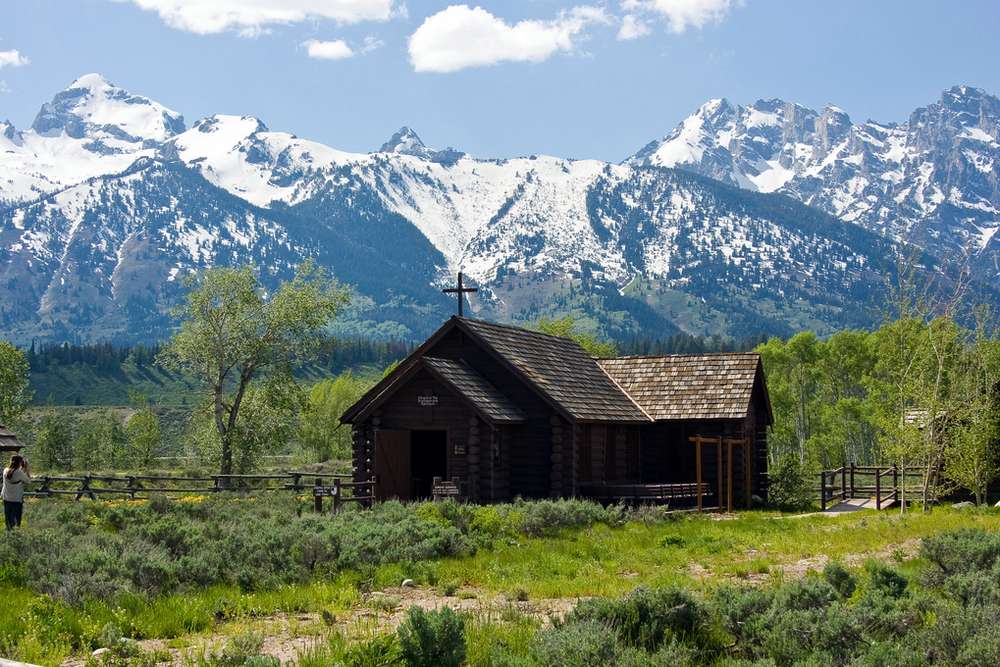
The Chapel of the Transfiguration in the Grand Teton National Park

The Chapel of the Transfiguration in the Grand Teton National Park, Wyoming

This rustic Episcopal Chapel of the Transfiguration was built in the summer of 1925. First services were held here on July 26 of that year, and on August 16, it was consecrated by The Rt. Reverend N. S. Thomas D.D., then Bishop of Wyoming.

The first suggestion for a chapel in this location was made about 1920 to a group seated around a campfire at the summer camp of Dr. George Woodward, of Chestnut Hill, Pennsylvania. Having made a long and tiresome trip that day from their camp near the outlet of Leigh Lake to the nearest place of worship in the town of Jackson, Mrs. Woodward expressed the wish that a chapel could be built at Menor’s Ferry, which was the center of what was the “dude ranch” portion of the valley. She discussed the idea with her friend, Miss Maude Noble, who owned and later generously donated the land where the chapel stands.
Plans for the building did not fully materialize until the early spring of 1925, when Archdeacon R.H. Balcom came to take charge of the Mission in Jackson’s Hole. He became actively interested in the idea, designed the building, and wrote of his plans to Mr. C. B. Voorhis, of Pasadena, California. Mr. Voorhis, who had a beautiful ranch on Torrey Lake, near Dubois in Wyoming, had been a lifelong friend of Bishop Thomas. He was greatly interested in the bishop’s work and had contributed significantly to the church and the first hospital in Jackson. Discussing the plans for a chapel at Menor’s Ferry with Bishop Thomas, Mr. Voorhis assured him that he and Mrs. Voorhis would be glad to finance the project. From that moment, work on the Chapel progressed rapidly.

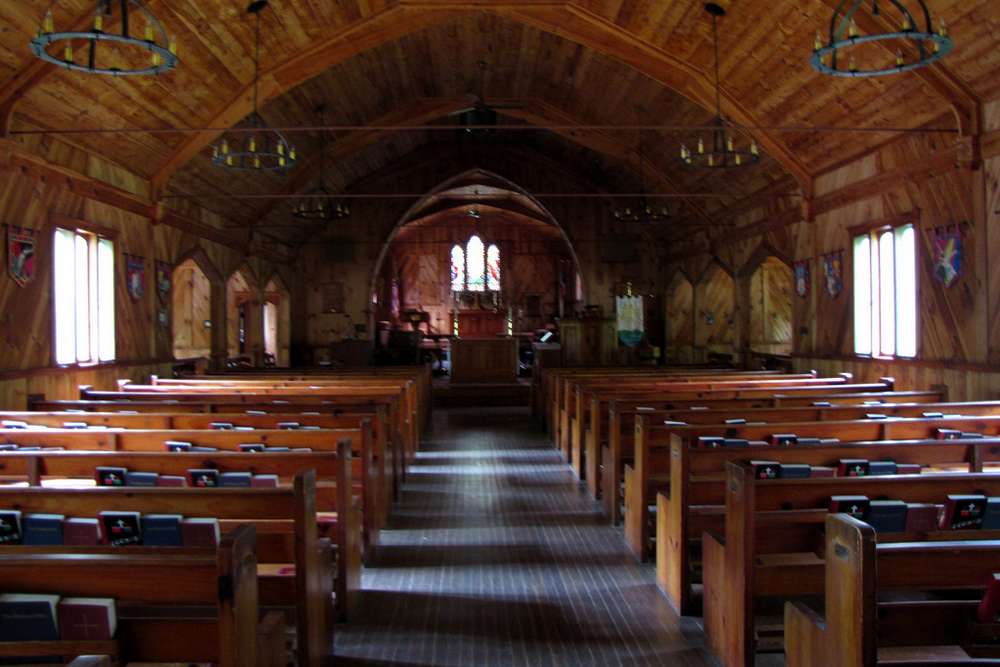
The Chapel is built of lodgepole pine, with pews of quaking aspen, cut in the valley. Above the altar is a plate glass reredos window framing the Grand Tetons. For twenty-four hours every day during the tourist season, the door is open to all who come.
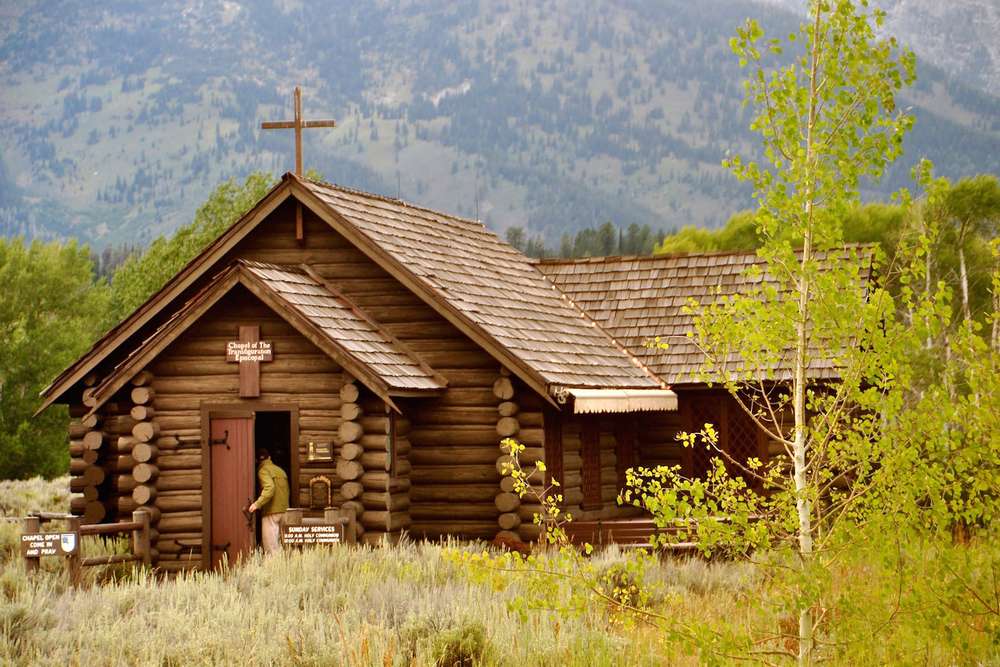
The Chapel is named most appropriately in commemoration of the Gospel story of the Transfiguration (Luke 9:28–36), where we are told of Jesus going into the mountains with Peter, James and John and appearing to them in the company of Moses and Elijah, resplendent in dazzling white clothing. Then a cloud enveloped them, and a voice said, “This is My beloved Son; listen to Him.” When the cloud went away, Jesus was seen, standing alone, by His disciples.

The Altar was given as a memorial by the C.B. Voorhis family; the font was given in memory of Miss Quita Woodward; the vestibule stained glass was presented by Miss Jessie Van Brunt. The bell, cast in 1842, is from St. Barnabas Church, Irvington, N.Y. The organ was given in 2009 by those who love worshipping here.

Address all communications to St. John’s Episcopal Church Jackson Hole in Jackson, Wyoming 83001.


Ben Franklin’s Fable of The Lion And The Dog

In January 1770, in the London newspaper The Public Advertiser, Benjamin Franklin published a fable about a young lion cub and a large English dog traveling together on a ship.

A lion’s whelp was put on board a Guinea ship bound to America as a present to a friend in that country: it was tame and harmless as a kitten, and therefore not confined, but suffered to walk about the ship at pleasure. A stately, full-grown English mastiff, belonging to the captain, despising the weakness of the young lion, frequently took its food by force, and often turned it out of its lodging box, when he had a mind to repose therein himself The young lion nevertheless grew daily in size and strength, and the voyage being long, he became at last a more equal match for the mastiff; who continuing his insults, received a stunning blow from the lion’s paw that fetched his skin over his ears, and deterred him from any future contest with such growing strength; regretting that he had not rather secured its friendship than provoked its enmity.

This is one of the many his articles, letters, hoaxes, and other pieces of political propaganda all aimed at convincing the British colonial powers that its oppressive treatment of the American colonies would sooner or later backfire. Franklin was acting in his capacity as the spokesman in London for several colonies.

Franklin “humbly inscribed” this to Lord Hillsborough, the British Secretary of State for the Colonies, who had become Franklin’s most ardent opponent.

Lord Hillsborough (Wills Hill, 1st Marquess of Downshire PC) served as the colonial secretary from 1768 to 1772, a critical period leading toward the American War of Independence.

For a great collection of the writings of Benjamin Franklin, see ‘A Benjamin Franklin Reader’ by Walter Isaacson. Not only was Franklin a self-made man, but he gave great advice about connecting with people and interacting with others both from a business and from a personal point of view.

The Best Jokes from Jerry Seinfeld

  • “I was the best man at the wedding. If I’m the best man, why is she marrying him?”
  • “The idea behind the tuxedo is the woman’s point of view that men are all the same; so we might as well dress them that way. That’s why a wedding is like the joining together of a beautiful, glowing bride and some guy. The tuxedo is a wedding safety device, created by women because they know that men are undependable. So in case the groom chickens out, everybody just takes one step over, and she marries the next guy.”
  • “It’s amazing that the amount of news that happens in the world every day always just exactly fits the newspaper.”
  • “Dogs are the leaders of the planet. If you see two life forms, one of them’s making a poop, the other one’s carrying it for him, who would you assume is in charge.”
  • “There’s very little advice in men’s magazines, because men don’t think there’s a lot they don’t know. Women do. Women want to learn. Men think, “I know what I’m doing, just show me somebody naked.””
  • “Sometimes the road less traveled is less traveled for a reason”
  • “According to most studies, people’s number one fear is public speaking. Number two is death. Death is number two. Does that sound right? This means to the average person, if you go to a funeral, you’re better off in the casket than doing the eulogy.”
  • “What is a date really, but a job interview that lasts all night? The only difference is that in not many job interviews is there a chance you’ll wind up naked.”
  • “To me, a lawyer is basically the person that knows the rules of the country. We’re all throwing the dice, playing the game, moving our pieces around the board, but if there is a problem the lawyer is the only person who has read the inside of the top of the box.
  • “Men want the same thing from their underwear that they want from women: a little bit of support, and a little bit of freedom.”
  • “Men don’t care what’s on TV. They only care what else is on TV.”
  • “I once had a leather jacket that got ruined in the rain. Why does moisture ruin leather? Aren’t cows outside a lot of the time? When it’s raining, do cows go up to the farmhouse, “Let us in! We’re all wearing leather! Open the door! We’re going to ruin the whole outfit here!””